Review Ducati DesertX (2026)

Completely New—890 cc, Monocoque, 209 kg, €16,390
New 890 cc V-twin without desmodromic valve actuation, aluminum monocoque frame doubling as the airbox, KYB suspension with 230/220 mm of travel, slim 18-liter polymer fuel tank, low center of gravity, crash pads from the factory. Erzbergrodeo, Rally Albania, NORRA Mexican 1000 Rally: Ducati did not develop the second-generation DesertX behind a desk. €16,390—€700 less than its predecessor.
As of: May 5, 2026 | Model: Ducati DesertX (2026; second generation; completely redesigned) | Manufacturer: Ducati Motor Holding S.p.A., Borgo Panigale, Bologna, Italy | Price in Germany: €16,390 plus €345 destination charges | Stationary noise: 93 dB(A)—Tyrol-compliant | Warranty: 4 years, Ducati 4Ever, unlimited mileage

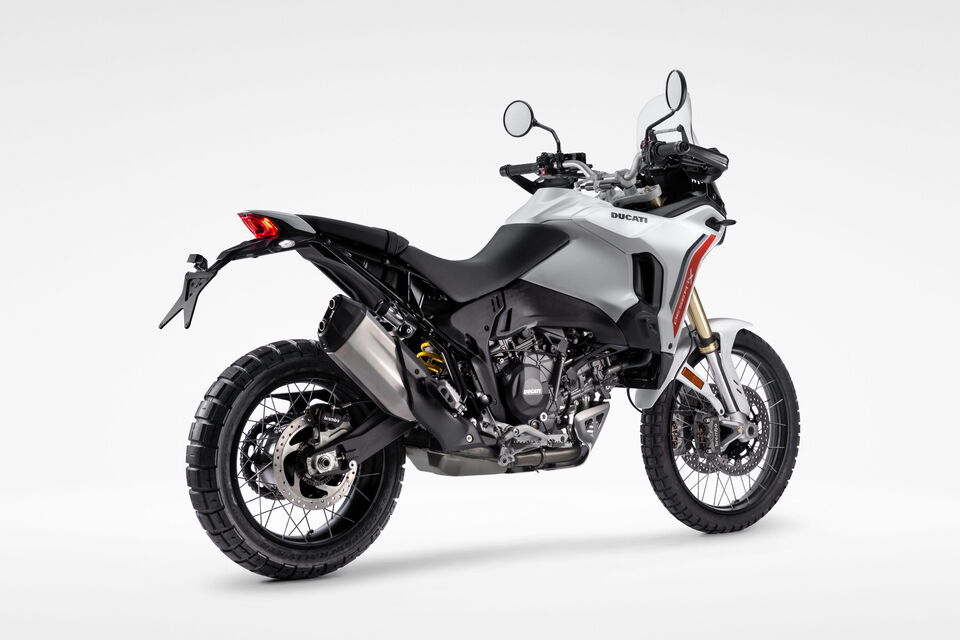
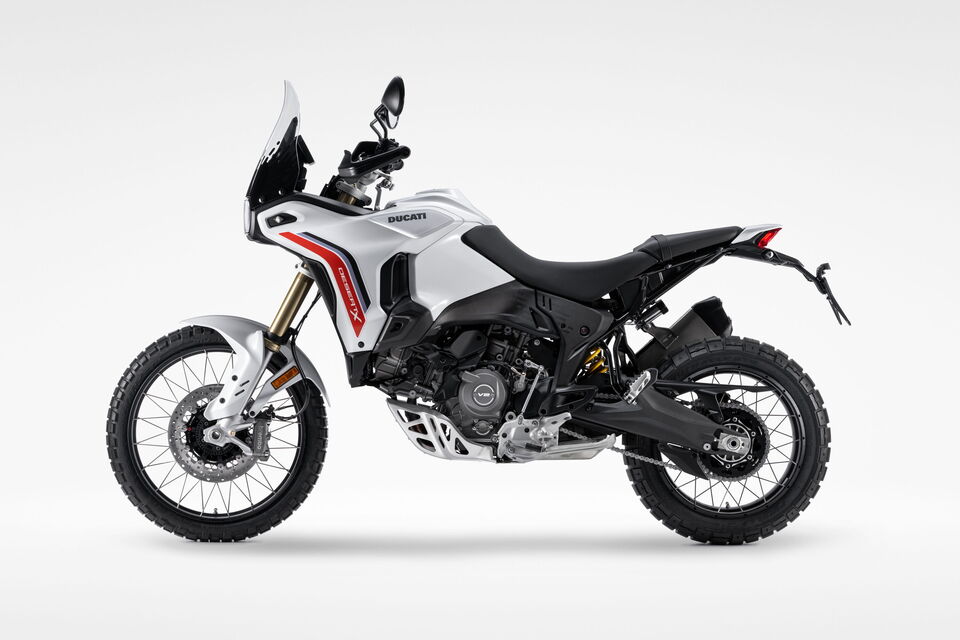
First Impression: Lighter, Slimmer, More Active—but Hardly Lighter Than Expected
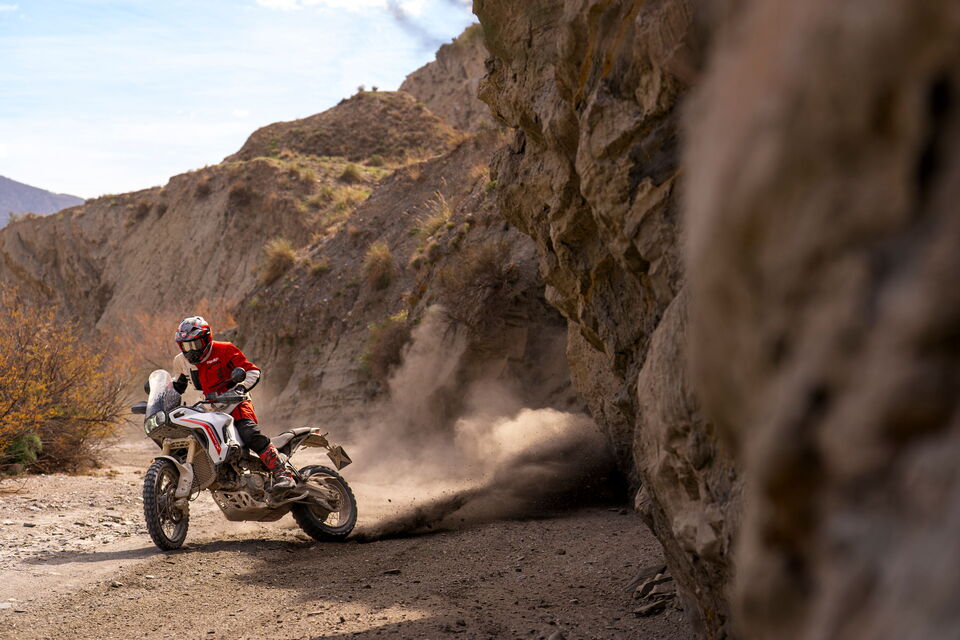
If you have ridden the first DesertX and now climb onto the new one, you feel the difference immediately—but not necessarily where you expect it. At 209 kg without fuel, the weight is virtually unchanged: just one kilogram less than its predecessor.
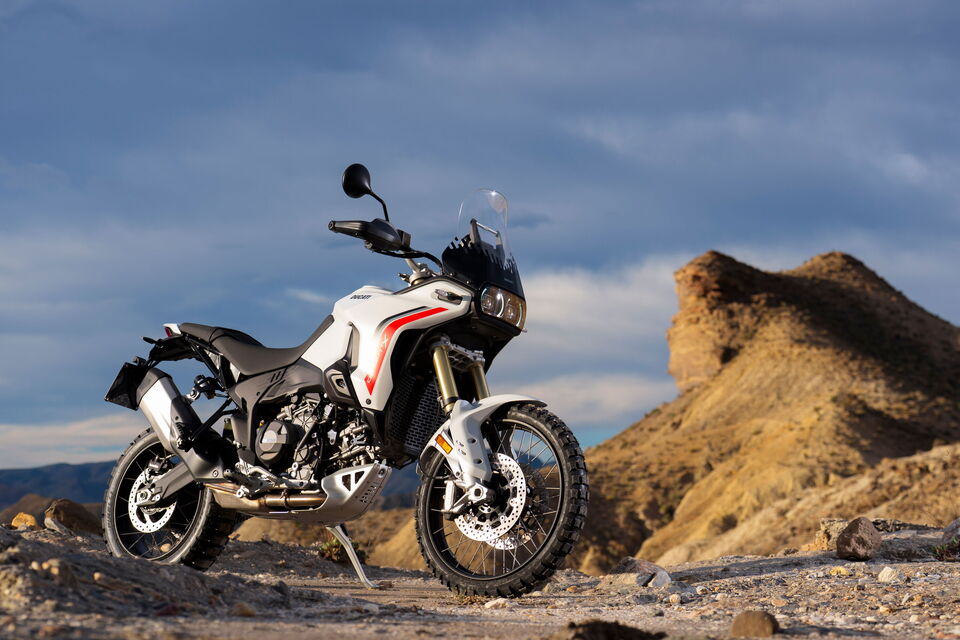
What has really changed is mass centralization. The new 18-liter polymer fuel tank is slimmer, sits lower, and carries less weight up high. The monocoque frame is more compact than the old tubular-steel frame. The motorcycle feels closer to the rider and less bulky—even though the scales tell a different story. You notice it off-road. You feel it on gravel.
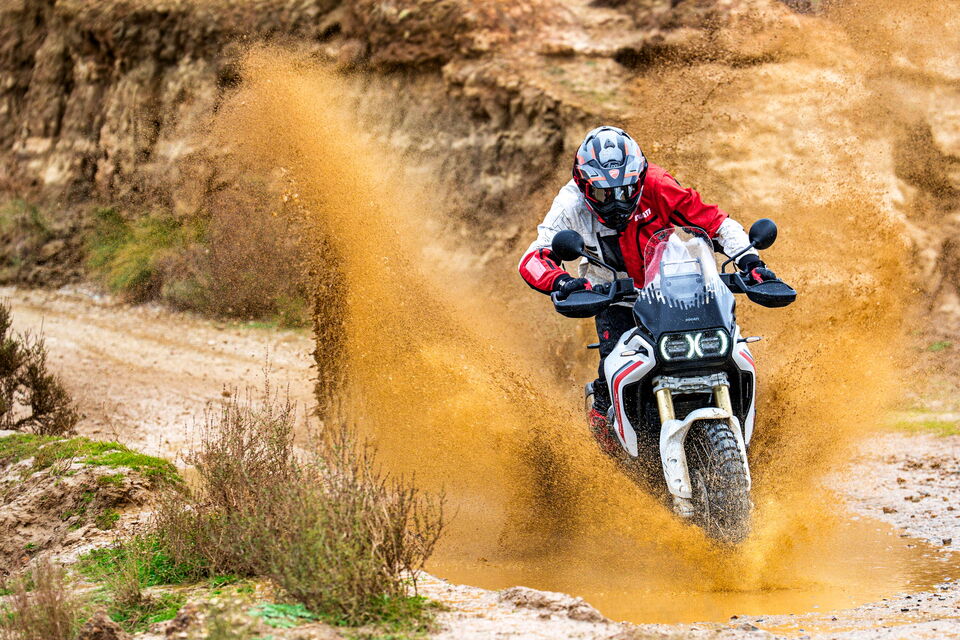
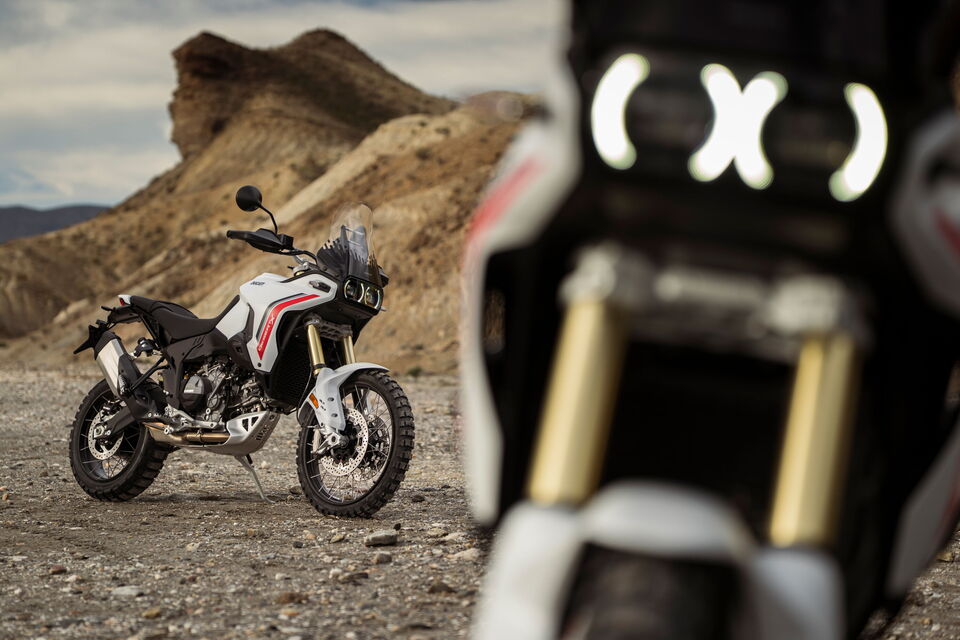
Standing on the footpegs—with the pegs positioned farther rearward than before and the handlebar and seat farther forward—the DesertX feels more manageable than its sister models. Wind protection is minimal. The bodywork is functional, not decorative, and factory-installed crash pads protect the fuel tank and frame areas during low-speed falls. This shows the philosophy: a motorcycle you are allowed to drop.
Engine: 890 cc, 110 hp, IVT—and Why No Desmo Is the Right Choice Here
The new 890 cc V-twin without desmodromic valve actuation is already familiar from the Multistrada V2, Monster, Panigale V2, and Streetfighter V2. In the DesertX, it runs in a specific off-road configuration. The first four gears are shorter than on the street models, while sixth gear is taller for improved highway efficiency. The result: off-road, the engine pulls strongly from low rpm without reacting excessively to abrupt throttle inputs.
The IVT system—Intake Variable Timing—ensures that more than 70 percent of maximum torque is already available at 3,000 rpm. Anyone who has ever wrestled a heavy single-cylinder motorcycle across gravel knows exactly how valuable that is in slow, technical sections. Valve-clearance inspection is due every 45,000 km—not every 30,000 km as with the predecessor’s Testastretta Desmo engine.
Anyone who sees the DesertX as an everyday adventure motorcycle rather than a racing machine will notice that difference at the next major service.
Or rather, will not have to notice it. That is the point.
Frame and Suspension: Monocoque as Airbox, KYB With Full Floater
The aluminum monocoque is not just the frame—it also serves as the airbox. The air filter is housed inside it, along with the throttle bodies and injectors. That makes the motorcycle slimmer, improves access for maintenance, and reduces the weight of the frame structure. At the rear, Ducati retains the proven tubular-steel trellis subframe: robust, repairable, and well suited to luggage racks and passenger loads.
The KYB suspension is the decisive step forward compared with the predecessor. The 46 mm USD fork now offers independent adjustment between the two fork legs, with compression and rebound damping adjusted separately, instead of the combined adjustment used previously. That gives the rider significantly greater scope to fine-tune the suspension to the terrain.
Anyone who has achieved anything at the Erzbergrodeo will be familiar with this. Anyone who simply rides gravel on Sundays will still benefit.
At the rear, the KYB shock with Full Floater progressive linkage and remote spring-preload adjuster completes the package. The spring rate becomes progressively firmer as the suspension compresses, allowing the system to deal more effectively with major off-road impacts than a linear setup.
Brakes: 305 mm, Brembo M4.32, Redesigned for Modulation
The 305 mm discs are smaller than the predecessor’s 320 mm rotors, but the Brembo M4.32 monobloc calipers remain the same. Ducati revised the brake-system geometry so that a high-mounted front fender can be fitted without additional brackets. That means more mud clearance above the front wheel—which in genuine off-road riding is worth more than another 15 mm of brake-disc diameter.
Bosch Cornering ABS can be adjusted through four levels. Levels 1 and 2 are intended for off-road riding, with progressively reduced intervention. Levels 3 and 4 are for the road. If you want no electronic intervention at the rear wheel, you can switch it off. That is exactly the flexibility an enduro motorcycle should provide.
Electronics: Six Riding Modes, IMU, Rally Mode Standard
There are six riding modes: Sport, Touring, Urban, Wet, Enduro, and Rally. The final two are optimized for off-road use and reduce DTC, DWC, EBC, and ABS intervention according to the requirements of the terrain. The 6-axis IMU supplies lean-angle data for Cornering ABS and traction control.
The 5-inch TFT display is now mounted horizontally instead of vertically. In off-road riding, the landscape orientation provides a better view of the area immediately in front of the front wheel when standing on the pegs.
There are three display modes: Road, Road Pro, and Rally. Cruise control comes standard. DMS and navigation are optional, with the necessary preparation included as standard.
Fuel Tank: 18 Liters—Less Than Before, but Better Positioned
The new polymer fuel tank holds 18 liters instead of the predecessor’s 21 liters.
In theory, that means around 30 to 40 km less range. If you want to compensate, Ducati offers an optional 8-liter auxiliary rear tank. When the main tank is empty, the display activates the auxiliary tank. Combined capacity: 26 liters. That is even more than before, so the trade-off makes sense.
A slimmer, lower-mounted main tank noticeably improves off-road handling by lowering the center of gravity. If you primarily ride on the road, order the auxiliary tank. If you want to ride off-road, stick with 18 liters.
93 dB(A) and Tyrol: The DesertX Is Allowed
The previous generation was rated at 93 dB(A) stationary noise under EU type approval and was therefore Tyrol-compliant. For the new 2026 generation, the figure has not yet been officially confirmed—check with your dealer. Based on the same engine architecture and comparable exhaust system, 93 dB(A) is the likely figure. The Tyrol limit is 95 dB(A).
DesertX vs. Discovery: When Is the Premium Worth It?
The DesertX Discovery, which will be covered in a separate review, adds 35- and 41-liter aluminum side cases, a centerstand, heated grips, crash bars, engine protection, radiator guard, handguards, and slightly taller wind protection to the standard DesertX. That is the touring package.
If you primarily ride off-road and do not need luggage, choose the standard DesertX. If you use the DesertX as a multipurpose adventure tourer and would check those accessory boxes anyway, the Discovery is less expensive as a package than buying everything separately.
Verdict: The Most Honest Off-Road Motorcycle in Ducati’s Lineup
The 2026 Ducati DesertX is the result of competition experience on genuine off-road terrain, not marketing theory developed in the comfort of an office. New 890 cc V-twin, monocoque frame, KYB suspension with 230/220 mm of travel, six riding modes, Brembo M4.32 brakes, 45,000 km valve-clearance intervals, four-year warranty. €16,390—€700 less than before. That is a fair price for a motorcycle you are allowed to drop.
Quick Check
+ 890 cc V-twin; IVT; no Desmo; 110 hp at 9,000 rpm; 92 Nm at 7,000 rpm; 70 percent of torque available from 3,000 rpm; off-road gearing with short first through fourth gears and tall sixth for efficiency; 45,000 km valve-clearance interval vs. 30,000 km for the Testastretta Desmo; 4-year warranty. Completely new motorcycle: monocoque frame with engine as a stressed member and integrated airbox, tubular-steel trellis rear subframe, 209 kg without fuel, 1 kg lighter than predecessor.
+ Fully adjustable 46 mm KYB USD fork with independent adjustment on both fork legs and separate compression/rebound damping; 230 mm front travel; KYB rear shock with remote spring-preload adjuster and Full Floater progressive linkage; 220 mm rear travel; Sachs steering damper. Crash pads standard for protection in low-speed falls; slim 18-liter polymer fuel tank for a lower center of gravity; footpegs farther rearward plus handlebar/seat farther forward for a more active off-road riding position.
+ Brembo M4.32 monobloc radial calipers; 305 mm discs with revised geometry allowing a high-mounted front fender without additional hardware; four-level Cornering ABS with Levels 1+2 for off-road and 3+4 for road use, rear ABS switchable. Six riding modes—Sport/Touring/Urban/Wet/Enduro/Rally; 6-axis IMU; DTC; DWC; EBC; horizontal 5-inch TFT with Road/Road Pro/Rally layouts; cruise control; 2× USB; full LED lighting; DRL; lithium-ion battery; DQS 2.0; A2 restriction to 35 kW available.
+ Tubeless wire-spoke wheels; 21-inch front / 18-inch rear; Pirelli Scorpion Rally STR, 90/90-21 front / 150/70-18 rear, with triple homologation for alternative Pirelli Scorpion tires. 880 mm standard seat height, 900 mm high, 860 mm low, 840 mm low with lowering kit. €16,390—€700 less than predecessor. Previous generation stationary noise: 93 dB(A), Tyrol-compliant; confirm 2026 figure with dealer.
– 18-liter main tank: 3 liters less than predecessor and approximately 30–40 km less range without auxiliary tank; optional 8-liter rear tank closes the range gap for a combined 26 liters. 209 kg without fuel may disappoint riders expecting a major weight reduction after the lighter-weight promise at EICMA; practically the same weight as predecessor. Approximately 222 kg with a full tank—still only marginally lighter than the competition.
– No DMS or navigation standard, although preparation is included and DMS is available as an accessory. No centerstand standard; Discovery includes one, Standard does not. No heated grips from the factory. Minimal wind protection limits comfort on long highway stretches; competitors such as the BMW F 800 GS and Honda Africa Twin 1100 provide more wind protection as standard.
– 2026 stationary-noise figure not yet officially confirmed—check with dealer. No standard integrated navigation. No four-stage rear-wheel ABS adjustment in Rally mode; rear ABS can be disabled but not adjusted through multiple levels. DesertX Rally retains the older Testastretta Desmo engine. If you want Desmo character, choose the Rally. If you want longer maintenance intervals, choose the standard DesertX.
Technical Specifications: Ducati DesertX (2026)
Make / Model: Ducati DesertX (2026; second generation; completely redesigned; available from April 2026); manufacturer: Ducati Motor Holding S.p.A., Borgo Panigale, Bologna, Italy
What’s New for 2026: Completely new design: 890 cc V-twin with IVT and no Desmo; aluminum monocoque frame with engine as a stressed member and integrated airbox; new KYB suspension with independently adjustable fork legs and Full Floater progressive linkage; slim 18-liter polymer tank; revised ergonomics with footpegs farther rearward and handlebar/seat farther forward; crash pads; new horizontal 5-inch TFT; 305 mm Brembo brakes
Standard vs. Discovery: Standard: no luggage, no centerstand, no heated grips. Discovery: aluminum side cases, 35 + 41 liters; centerstand; heated grips; crash bars; engine protection; radiator guard; handguards; taller wind protection. Engine and suspension are identical.
Engine: Liquid-cooled 90-degree V-twin; 890 cc; DOHC; no Desmo; IVT, Intake Variable Timing; 6-speed transmission with short first through fourth gears for off-road riding and tall sixth for efficiency; DQS 2.0; wet multi-plate clutch; Euro 5+; A2 restriction to 35 kW available
Power / Torque: 110 hp (81 kW) at 9,000 rpm; 92 Nm at 7,000 rpm; more than 70 percent of torque available from 3,000 rpm
Top Speed / Consumption: Approx. 200 km/h; approx. 5.0–5.5 L/100 km; approx. 327–360 km range with 18-liter tank; optional 8-liter auxiliary tank provides 26 liters total capacity
Fuel Tank / Weight: 18-liter polymer tank, slim with low center of gravity; 209 kg with fluids but without fuel; approx. 222 kg fully fueled; optional 8-liter auxiliary rear tank
Transmission / Final Drive: 6-speed; chain drive; DQS 2.0 Up/Down
Electronics: Six riding modes—Sport/Touring/Urban/Wet/Enduro/Rally; DTC; DWC; EBC; four-level Cornering ABS with Levels 1+2 for off-road and 3+4 for road use, rear ABS switchable; 6-axis IMU; horizontal 5-inch TFT with Road/Road Pro/Rally display modes; cruise control; 2× USB; full LED lighting; DRL; lithium-ion battery; DMS preparation; navigation available as an accessory
Frame: Aluminum monocoque with engine + airbox as stressed elements; tubular-steel trellis rear subframe; aluminum double-sided swingarm developed specifically for DesertX
Front Suspension: 46 mm KYB USD fork; fully adjustable with independently adjustable fork legs and separate compression/rebound damping; 230 mm travel
Rear Suspension: Fully adjustable KYB shock; remote spring-preload adjuster; Full Floater progressive linkage; 220 mm travel; Sachs steering damper
Front Brakes: Brembo M4.32 monobloc calipers; dual 305 mm discs; revised geometry allowing high-mounted fender without additional hardware; Bosch Cornering ABS; new radial master cylinder
Rear Brake: Brembo disc brake; ABS switchable
Wheels / Tires: Tubeless wire-spoke wheels; 21-inch front / 18-inch rear; Pirelli Scorpion Rally STR; 90/90-21 front / 150/70-18 rear; triple homologation for alternative Pirelli Scorpion tires
Ergonomics: 880 mm standard seat height, 900 mm high, 860 mm low, 840 mm low with lowering kit; footpegs farther rearward; handlebar and seat farther forward; wide handlebar; slim waist around the knee area; factory crash pads; no centerstand standard
Stationary Noise: 93 dB(A) for previous generation according to EU type approval; confirm figure for new 2026 generation with dealer; Tyrol limit 95 dB(A)
Accessories: Optional 8-liter rear auxiliary tank; aluminum luggage with mounts; Mosko Moto soft bags; radiator guard; crash bars; centerstand; heated grips; street-legal Termignoni exhaust with +7 percent power; Rally Nav
2026 Colors: Matt Star White Silk; ask dealer about additional options
Warranty / Service: 4 years, Ducati 4Ever, unlimited mileage; valve-clearance inspection every 45,000 km; oil change every 15,000 km / 24 months
Price (Germany): €16,390 plus €345 destination charges, €700 less than predecessor