Review Ducati Diavel V4 RS (2026)

182 hp Desmosedici Stradale, Öhlins, Carbon, 0–100 km/h in 2.5 Seconds, Numbered—€38,990
The Diavel V4 RS is the most uncompromising interpretation of the Diavel concept: 182 hp from the Desmosedici Stradale engine—the same powerplant used in the Panigale and Streetfighter—wrapped in a muscle-cruiser package. Öhlins suspension, dry clutch, carbon bodywork, forged wheels, Race mode. Numbered aluminum plaque. 0–100 km/h in 2.5 seconds.
As of: May 2, 2026 | Model: Ducati Diavel V4 RS (2026; new model; limited numbered series; Desmosedici Stradale engine) | Manufacturer: Ducati Motor Holding S.p.A., Borgo Panigale, Bologna, Italy; subsidiary of Audi AG | Price in Germany: €38,990 plus €345 destination charges | Stationary noise: not officially published; check with dealer, Tyrol limit 95 dB(A) | Warranty: 2-year manufacturer warranty; valve-clearance inspection every 30,000 km
What Separates the RS From the Diavel V4—and What They Share
The Diavel V4 RS and Diavel V4 share the same basic frame concept, single-sided swingarm, 240 rear tire, and fundamental Diavel proportions. The decisive difference is the engine. The RS uses the 1,103 cc Desmosedici Stradale with desmodromic valve actuation. The standard V4 uses the 1,158 cc Granturismo with conventional valve springs.
The result is 182 hp instead of 168 hp—and a completely different engine character. The standard V4’s Granturismo pulls hard and broadly, delivering substantial torque from low rpm. The RS’s Desmosedici Stradale wants to rev. It comes alive between 8,000 and 13,500 rpm, where it shows its best character, leaving no doubt that it was originally developed for the Panigale.
Buy the RS and spend most of your time in city traffic and on backroads below 6,000 rpm, and you have chosen the wrong motorcycle. Buy it because you want an engine that breathes through corners and becomes frighteningly good at the top of the rev range, and you have chosen the right one.
Engine: Desmosedici Stradale—182 hp, Dry Clutch, 13,500 rpm
1,103 cc, liquid-cooled, 90-degree V4, DOHC, desmodromic valve actuation, counter-rotating crankshaft, four valves per cylinder, 182 hp at 11,750 rpm, 120 Nm at 9,500 rpm, rev limiter at 13,500 rpm—14,000 rpm in first gear—six-speed transmission, STM-EVO-SBK dry clutch, Quick Shift 2.0, Euro 5+, cylinder-deactivation system for the rear cylinders when stationary or in neutral. The engine is also a structural component and performs part of the frame’s function.
The RS produces 120 Nm at 9,500 rpm, nominally 6 Nm less than the standard V4’s Granturismo, which produces 126 Nm at 7,500 rpm. That comparison is misleading. The Desmosedici builds its torque higher in the rev range and holds it longer. Open the throttle in third gear at 9,000 rpm and run through the next 4,000 rpm, and you experience a level of power delivery the Granturismo simply cannot match.
Then there is the dry clutch. It rattles characteristically at idle, looks dramatic, and creates a sensation reminiscent of a racebike. This is not a feature designed for comfort, but it is a statement of character and intent.
Fuel consumption is approximately 6.5 L/100 km. The 20-liter fuel tank provides around 305 km of range. Cylinder deactivation while stationary and in neutral reduces the amount of heat reaching the rider—which is a tangible comfort advantage when riding a high-compression V4 in city traffic.
Chassis: Öhlins NIX30 + STX46, Forged Wheels, 235 kg
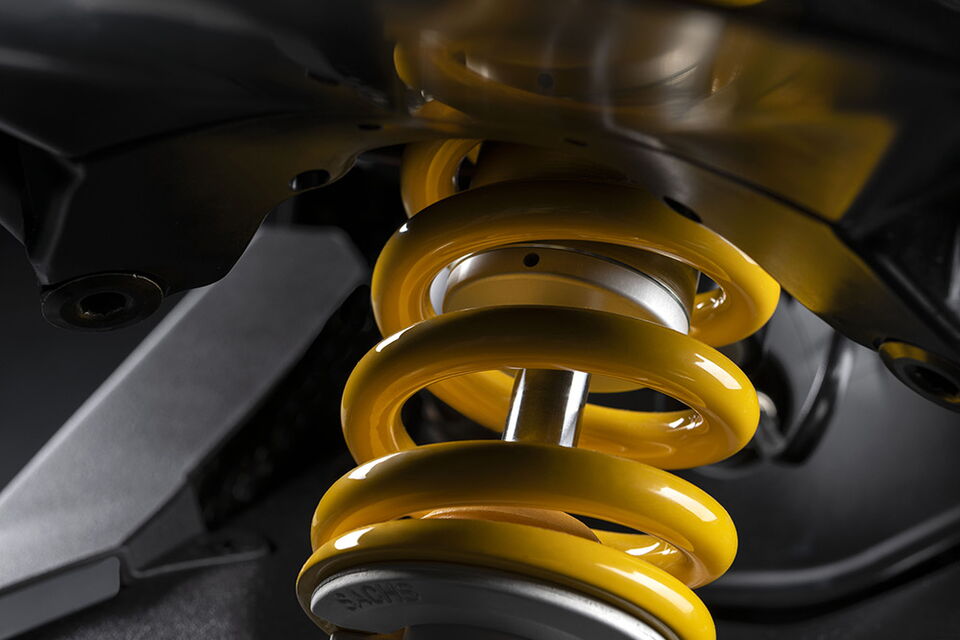
Up front is a fully adjustable 48 mm Öhlins NIX30 USD fork with approximately 127 mm of travel. At the rear is a fully adjustable Öhlins STX46 monoshock with a single-sided swingarm.
Braking comes from Brembo Stylema monobloc calipers gripping dual 330 mm front discs, backed by Cornering ABS EVO. This is the highest-specification chassis Ducati has ever installed on a Diavel. The Öhlins NIX30 and STX46 are premium components developed for track and high-performance applications and calibrated on the Diavel RS for road use. The result is authoritative control on good pavement without sacrificing comfort.
The RS weighs 235 kg ready to ride—1 kg less than the standard V4 at 236 kg. The weight reduction comes from carbon bodywork components—air intakes, solo tail section, fenders, fuel-tank covers—plus forged-aluminum wheels, which are lighter than cast wheels and reduce unsprung mass, and a lithium-ion battery. Less unsprung mass allows the suspension to respond more quickly to surface irregularities. You can feel the difference on poor pavement.
Ergonomics: 790 mm, Solo Seat, Race Position
Seat height is 790 mm. Wheelbase is 1,602 mm. The RS comes configured as a single-seater. The carbon tail section is compact and sculptural. If you want to carry a passenger, the tail can be converted using the optional passenger setup. Retractable passenger footpegs and a fold-out grab handle are integrated into the chassis.
The fundamental riding position differs only marginally from the standard V4: upright, slightly forward-mounted footpegs, wide handlebar. This is not superbike suffering. Even as an RS, the Diavel remains a motorcycle you can ride for two hours without physical punishment.
What is different is the display. The RS gets a 6.5-inch TFT screen compared with the standard V4’s 5-inch unit. The display offers smartphone mirroring and a ventilated smartphone compartment beneath the instrument panel to prevent the device from overheating while charging. It is a small detail that will be appreciated in everyday use.
Electronics: Race Mode, Three-Level DPL, Lap Timer
The electronics package includes a 6-axis IMU, four riding modes—Race, Sport, Touring, Wet—with Race exclusive to the RS and unavailable on the standard V4, three Power Modes, cornering DTC traction control, DWC wheelie control, three-level Ducati Power Launch, Cornering ABS EVO, Quick Shift 2.0, cruise control, Hands-Free keyless operation, Lap Timer, native turn-by-turn navigation, and USB.
Race mode is the most important electronic distinction from the standard V4. It sharpens everything—throttle response, traction-control intervention thresholds, quickshifter behavior—to a level that only really makes sense on the road when the road is empty and the surface is good.
In Touring mode, the RS is surprisingly manageable. The systems intervene later, throttle mapping becomes more linear, and the engine is more docile than expected.
Three-level DPL is the highlight of the launch electronics. With DPL activated, the system holds engine speed in the optimum range during launch and controls torque delivery as the clutch engages. The result is 0–100 km/h in 2.5 seconds. That is faster than most supersport motorcycles.
Stationary Noise and Tyrol
The Diavel V4 RS’s stationary-noise figure has not been officially published. The standard Diavel V4 is rated at 97 dB(A), already exceeding Tyrol’s 95 dB(A) limit. The RS, with its Desmosedici Stradale engine and dry clutch, is not acoustically quieter.
Anyone who regularly rides on Tyrolean Alpine roads should clarify the figure with the dealer before buying. It would be quite an unwelcome surprise to discover that a €38,990 motorcycle cannot legally be ridden on certain Austrian roads.
Price and Positioning
€38,990 plus €345 destination charges. Two-year warranty. Valve-clearance inspection every 30,000 km. That is almost €11,000 more than the standard Diavel V4 at €28,190.
For that premium you get the Desmosedici Stradale instead of the Granturismo, Öhlins suspension instead of Marzocchi, forged wheels instead of cast wheels, carbon bodywork, dry clutch, Race mode, 6.5-inch TFT, Lap Timer, numbered aluminum plaque, and 14 additional horsepower.
If you use those things, you are getting what you paid for. If you do not, buy the standard V4.
Verdict
The 2026 Ducati Diavel V4 RS is the fastest-accelerating production motorcycle Ducati has ever built. It has an engine from the Panigale, suspension from the supersport parts shelf, carbon bodywork, and a limited production number on the rear cylinder head. For riders who want Desmosedici Stradale character in cruiser proportions and are prepared to pay €38,990, there is nothing else like it.
Quick Check
+ Desmosedici Stradale: 182 hp at 11,750 rpm; 120 Nm at 9,500 rpm; 13,500 rpm rev limiter; desmodromic valve actuation; STM-EVO-SBK dry clutch; counter-rotating crankshaft; 0–100 km/h in 2.5 seconds; three-level Ducati Power Launch
+ Fully adjustable 48 mm Öhlins NIX30 USD fork; fully adjustable Öhlins STX46 shock; Brembo Stylema; 235 kg ready to ride, 1 kg lighter than standard V4 thanks to carbon + forged wheels + lithium-ion battery; Race mode exclusive to RS; Lap Timer; 6.5-inch TFT with smartphone mirroring and ventilated compartment
+ Numbered aluminum plaque on rear cylinder head; carbon air intakes/tail section/fenders/fuel-tank covers; three-color RS paint scheme; limited numbered series; cylinder deactivation when stationary/in neutral; Cornering ABS EVO; 6-axis IMU
+ 2-year warranty; valve-clearance inspection every 30,000 km; optional passenger seat with retractable footpegs + grab handle integrated into chassis; 20-liter tank; approx. 305 km range; 6-speed Quick Shift 2.0
– Stationary noise not published; Tyrol limit 95 dB(A). Standard Diavel V4 is rated at 97 dB(A); RS with Desmosedici and dry clutch is not acoustically quieter. Confirm with dealer before riding in Tyrol.
– €38,990: almost €11,000 more than standard V4. If you do not rev the engine hard or use Race mode, you are paying heavily for unused potential. Standard V4 at €28,190 is the more sensible choice for everyday riders.
– Desmosedici Stradale wants to rev. In city traffic below 6,000 rpm, the RS is outside its natural operating range. Dry clutch rattles at idle. Valve-clearance inspection every 30,000 km versus 60,000 km on standard V4—twice as frequent and more expensive.
– Only single-seater as standard, with passenger setup available at extra cost. 6.5-inch TFT without standalone native navigation, using smartphone mirroring instead; no independent navigation system. Limited production—once sold out, no further purchase possible.
Technical Specifications: Ducati Diavel V4 RS (2026)
Make / Model: Ducati Diavel V4 RS (2026; new model; limited numbered series; Desmosedici Stradale engine); manufacturer: Ducati Motor Holding S.p.A., Borgo Panigale, Bologna, Italy
V4 RS vs. Diavel V4 Standard: RS: Desmosedici Stradale, 1,103 cc, 182 hp, Desmo, dry clutch, 13,500 rpm, Race mode, Öhlins, forged wheels, carbon, 235 kg, €38,990. Standard V4: Granturismo, 1,158 cc, 168 hp, valve springs, Marzocchi, cast wheels, 236 kg, €28,190.
Engine: Liquid-cooled 90-degree V4 Desmosedici Stradale; 1,103 cc; DOHC; desmodromic valve actuation; counter-rotating crankshaft; four valves per cylinder; semi-dry-sump lubrication; cylinder deactivation for rear cylinders while stationary/in neutral; six-speed transmission; STM-EVO-SBK dry clutch; Quick Shift 2.0; Euro 5+
Power: 182 hp (134 kW) at 11,750 rpm; rev limiter 13,500 rpm, 14,000 rpm in first gear
Torque: 120 Nm at 9,500 rpm
Top Speed / Consumption: Approx. 270 km/h; 0–100 km/h in 2.5 seconds; approx. 6.5 L/100 km; approx. 305 km range
Fuel Tank / Weight: 20 liters; 235 kg ready to ride, 1 kg lighter than standard Diavel V4
Transmission / Final Drive: 6-speed; chain drive; dry clutch; Quick Shift 2.0
Electronics: 6-axis IMU; four riding modes—Race/Sport/Touring/Wet, with Race exclusive to RS; three Power Modes; cornering DTC traction control; DWC wheelie control; three-level Ducati Power Launch; Cornering ABS EVO; Quick Shift 2.0; cruise control; Hands-Free; Lap Timer; turn-by-turn navigation; 6.5-inch TFT with smartphone mirroring and ventilated compartment; USB
Front Suspension: Öhlins NIX30; 48 mm USD; fully adjustable for rebound, compression, and spring preload; approx. 127 mm travel
Rear Suspension: Öhlins STX46; monoshock; fully adjustable; single-sided swingarm
Front Brakes: Brembo Stylema monobloc calipers; dual 330 mm discs; Cornering ABS EVO
Rear Brake: 245 mm disc; Cornering ABS EVO
Wheels: Forged-aluminum wheels; 17-inch front; 17-inch rear with single-sided swingarm
Tires: Pirelli Diablo Rosso IV; 120/70 ZR17 front; 240/45 ZR17 rear
Ergonomics: 790 mm seat height; 1,602 mm wheelbase; upright riding position with slightly forward-mounted footpegs; single-seat configuration standard with carbon tail section; passenger setup can be retrofitted with retractable footpegs + grab handle integrated into chassis
Carbon Components Standard: Air intakes; solo tail section; front and rear fenders; side fuel-tank covers; cockpit fairing; clutch cover
Special Features: Numbered aluminum plaque on rear cylinder head; RS logo in paintwork and display graphics; 6.5-inch TFT with ventilated smartphone compartment; lithium-ion battery; three-color RS paint scheme
Stationary Noise: Not officially published; confirm with dealer. Tyrol limit 95 dB(A); standard Diavel V4 is rated at 97 dB(A).
Warranty / Service: 2-year manufacturer warranty with unlimited mileage; valve-clearance inspection every 30,000 km, compared with 60,000 km on standard V4; service every 15,000 km / 2 years
Price (Germany): €38,990 plus €345 destination charges; limited numbered series