Review Kawasaki Ninja 1100 SX (2026)

The Sport-Tourer With a Turbine-Smooth Four-Cylinder, Bidirectional Quickshifter, Cruise Control, and 136 hp for EUR 15,520
1,099 cc, 136 hp, 113 Nm. A bidirectional quickshifter from 1,500 rpm, cruise control, IMU, cornering ABS, and USB-C are standard on both versions. Curb weight is 235 kg. For 2026, the Ninja 1100 SX is technically identical to MY2025—new colors, same convincing foundation. The 1100 SX SE with Öhlins, Brembo, and heated grips is covered in a separate review.
As of: April 15, 2026 | Model: Kawasaki Ninja 1100 SX (2026, base) | Price: EUR 15,520 including destination | Warranty: 4 years | Euro 5+ | MY2026: technically identical to MY2025, new colors

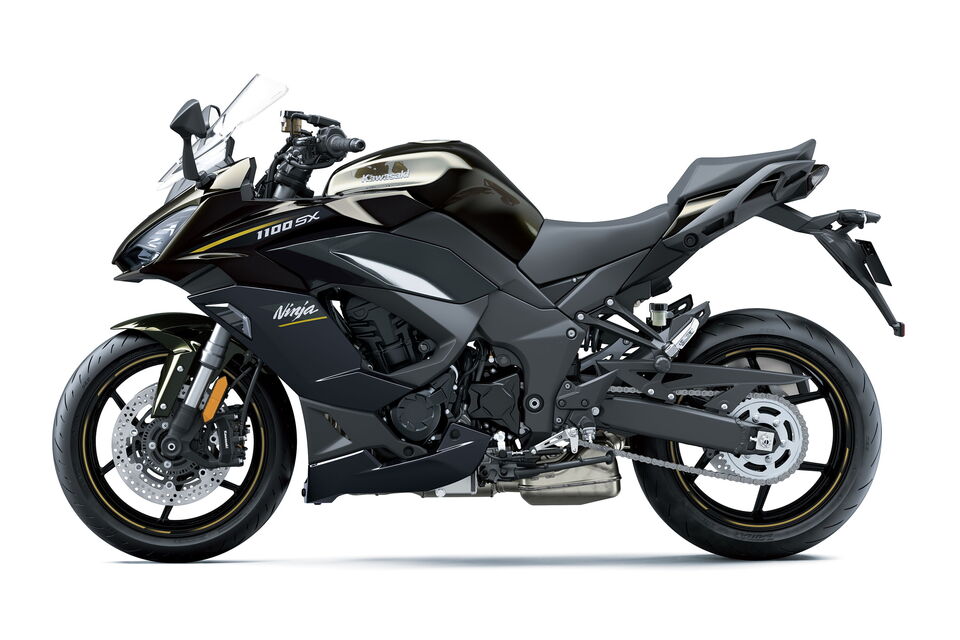
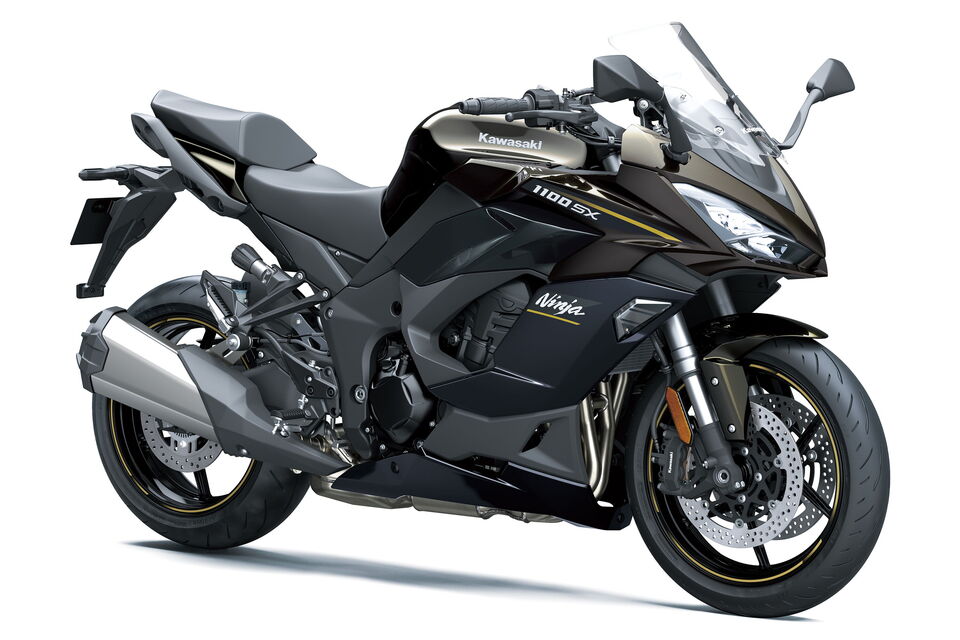
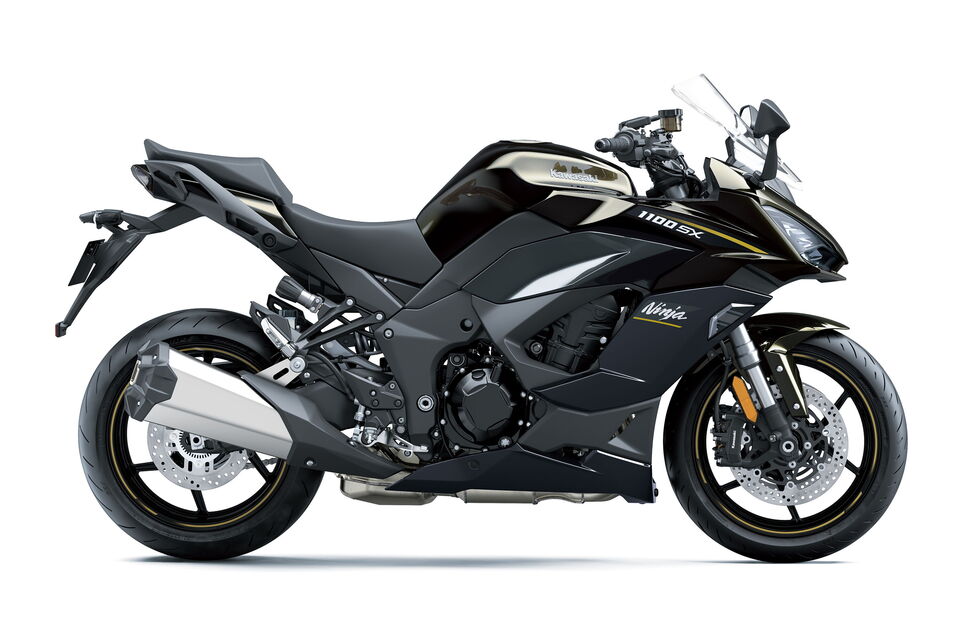
Positioning: What Separates the Ninja 1100 SX From the SE—and What Both Share as Standard
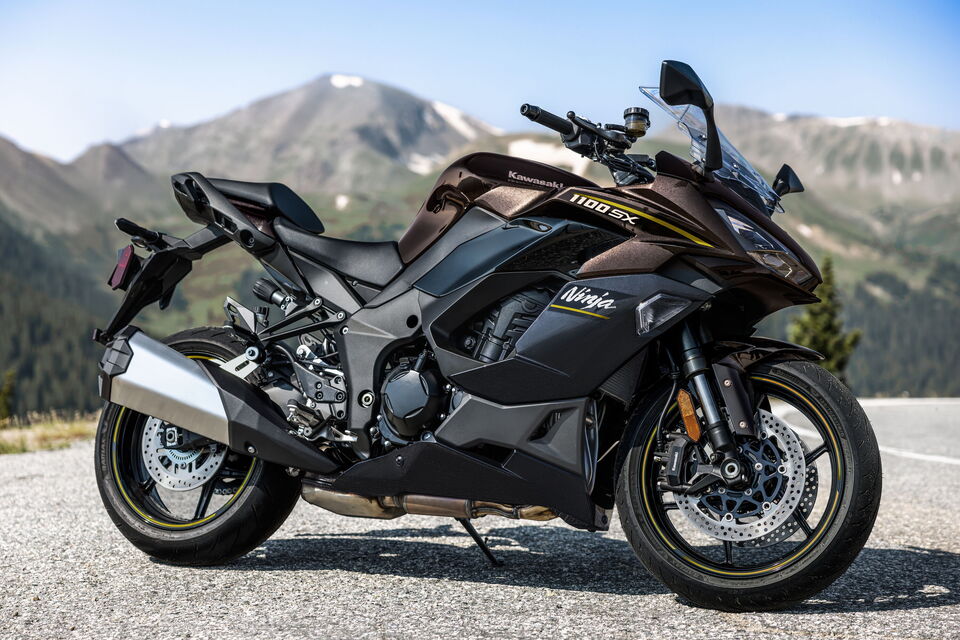
The Ninja 1100 SX and its SE variant share the same engine, frame, geometry, front fork, and extensive electronics package. Both come standard with a bidirectional Kawasaki Quick Shifter, KQS, operating from 1,500 rpm, cruise control, IMU-supported cornering ABS, lean-sensitive traction control, four riding modes—Sport, Road, Rain, and Rider—a USB-C charging port, and an adjustable windshield. The SE adds an Öhlins S46 rear shock instead of the Showa unit, Brembo M4.32 four-piston fixed calipers with steel-braided lines instead of Nissin brakes, heated grips as standard, and an integrated luggage system.
The SE costs EUR 1,650 more. This review covers the base version only. Riders who prioritize higher-grade braking and suspension components and are prepared to pay the premium should refer to the separate SE review. For 2026, both versions receive new colors only; the technical package is unchanged.
Engine: 1,099 cc, 136 hp, 113 Nm—Turbine-Smooth, With Noticeably More Midrange Than Its Predecessor
The liquid-cooled 1,099 cc inline-four is based on the Ninja 1000SX engine but uses a revised crankpin arrangement and reworked intake ports to produce more torque at low and midrange rpm. The result is easy to feel. The 1100 SX pulls harder from low revs than the 1000 SX, is happier being left in a taller gear, and delivers stronger passing acceleration without requiring a downshift. The engine is often described as turbine-like, and the term fits: almost no abrupt load-change reaction, no stumbling, no constant-throttle surging—just linear, silky-smooth drive.
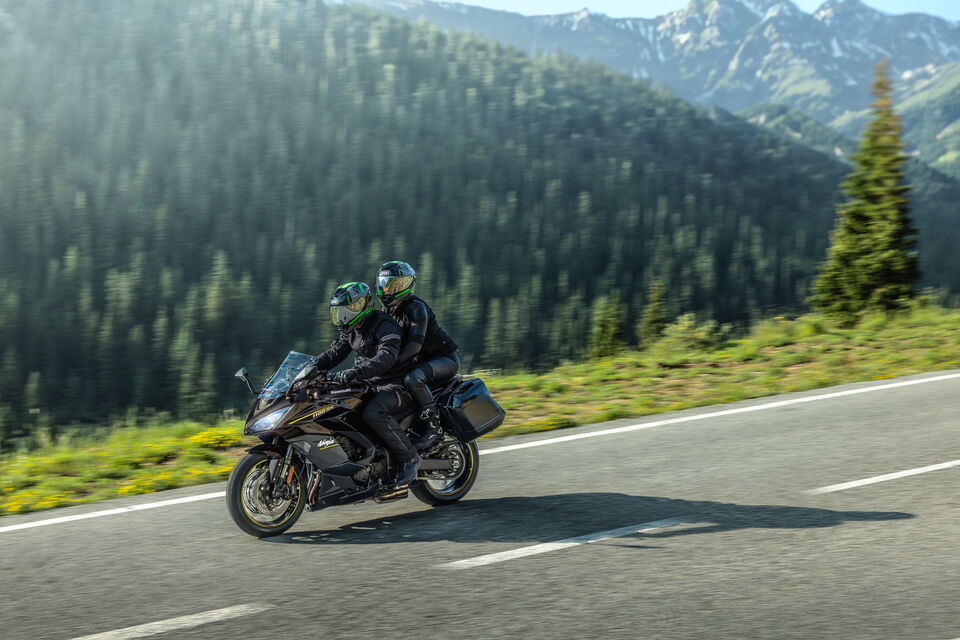
The engine will even pull sixth gear at 50 km/h and around 1,500 rpm without complaint. Higher in the rev range, the performance remains engaging without the aggression of a supersport engine. For a sport-tourer, that is exactly right: enough reserve for spontaneous passes on tight backroads and relaxed highway travel at 130 km/h without constantly working the gearbox.
Two criticisms remain. Between 6,000 and 8,000 rpm, high-frequency vibration can be felt through the hands and seat. Heavier bar-end weights have reduced it compared with the predecessor, but have not eliminated it completely.
Quickshifter: Bidirectional, From 1,500 rpm—One of the Biggest Improvements Over the Predecessor
The bidirectional Kawasaki Quick Shifter is one of the most noticeable improvements of the 1100 over the 1000 SX. The previous system worked from 2,500 rpm and could feel notchy at partial throttle. The new KQS operates from just 1,500 rpm and shifts reliably with a pleasantly brief interruption in drive, largely independent of load. That is a genuine everyday benefit. In city traffic and during slow approaches, a quickshifter that does not demand higher revs is considerably more pleasant.
Combined with the exceptionally smooth engine, the result feels almost clockwork-like: gear changes without a noticeable break, acceleration without drama. Riders moving from a motorcycle without a quickshifter may wonder after a few days why they waited so long.
Electronics: Cruise Control, IMU, Cornering ABS, Four Riding Modes, Rideology App With Voice Commands—Complete Standard Equipment
The electronics package on the base Ninja 1100 SX is comprehensive for a sport-tourer at this price. Four riding modes—Sport, Road, Rain, and Rider—cover a broad range of conditions. Rider mode allows engine mapping and traction control to be configured individually. The IMU continuously monitors lean angle and coordinates ABS and traction control accordingly. KIBS, Kawasaki Intelligent anti-lock Brake System, and KTRC lean-sensitive traction control therefore respond more appropriately to cornering conditions than conventional systems without IMU input. KCMF, Kawasaki Cornering Management Function, additionally monitors engine and chassis parameters through a turn and coordinates braking force and engine output for greater stability.
Cruise control is standard—essential equipment on a long-distance sport-tourer. USB-C is standard as well, although several tests have criticized the installation for looking somewhat crude. The Kawasaki Rideology app now supports voice commands. The 4.3-inch TFT is clear and readable, though smaller than newer Kawasaki displays. One operating detail is unnecessarily awkward: changing riding modes requires a long press of the up/down buttons because a short press uses the same buttons for trip-computer navigation.
Chassis: Fully Adjustable 41 mm Showa USD Fork, Showa Rear Shock—Well Balanced for Sport-Touring
Up front is a fully adjustable 41 mm Showa upside-down fork with 120 mm of travel and adjustment for compression damping, spring preload, and rebound damping. The base model uses a Showa rear shock adjustable for rebound and preload. The suspension is well balanced for sport-touring: it absorbs poor surfaces confidently while still providing enough feedback for precise cornering. Sport riders pushing hard will reach the limits of the Showa rear shock before those of the fork, but for everyday riding and long-distance touring, the calibration is very well judged.
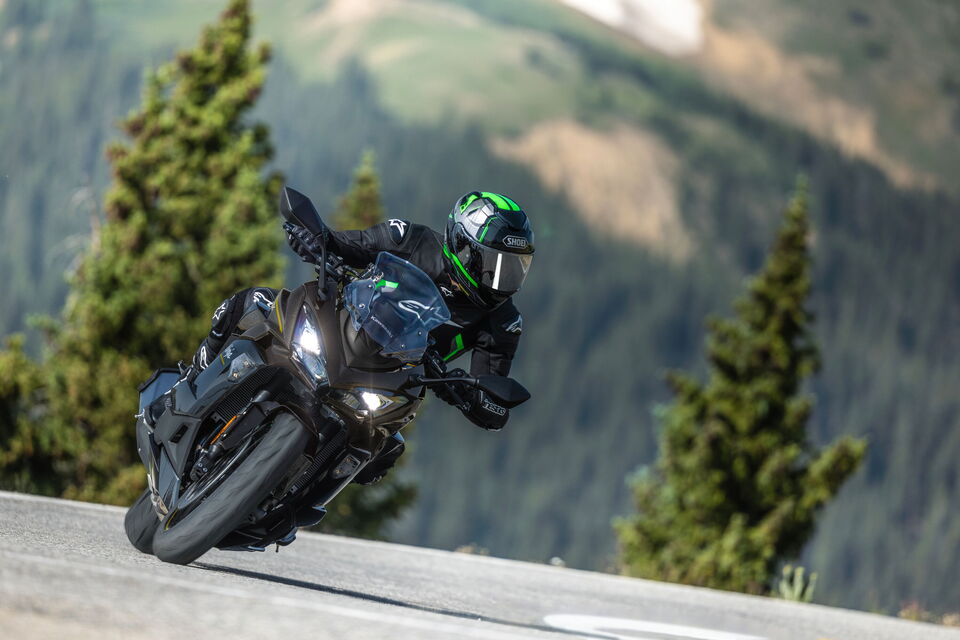
The aluminum frame combines high rigidity with good mass centralization. Despite a 235 kg curb weight, the motorcycle feels surprisingly agile and turns with little effort without becoming jittery. Straight-line stability is excellent. On tight backroads, the bike is genuinely enjoyable, though very tight hairpins require a little patience. Bridgestone Battlax S23 sport tires come standard, offering strong grip, quick warm-up, and a good compromise between sport performance and everyday use.
Ergonomics and Windshield: Comfortable Riding Position, 835 mm Seat Height, Good Wind Protection—but Adjustment Only at a Stop
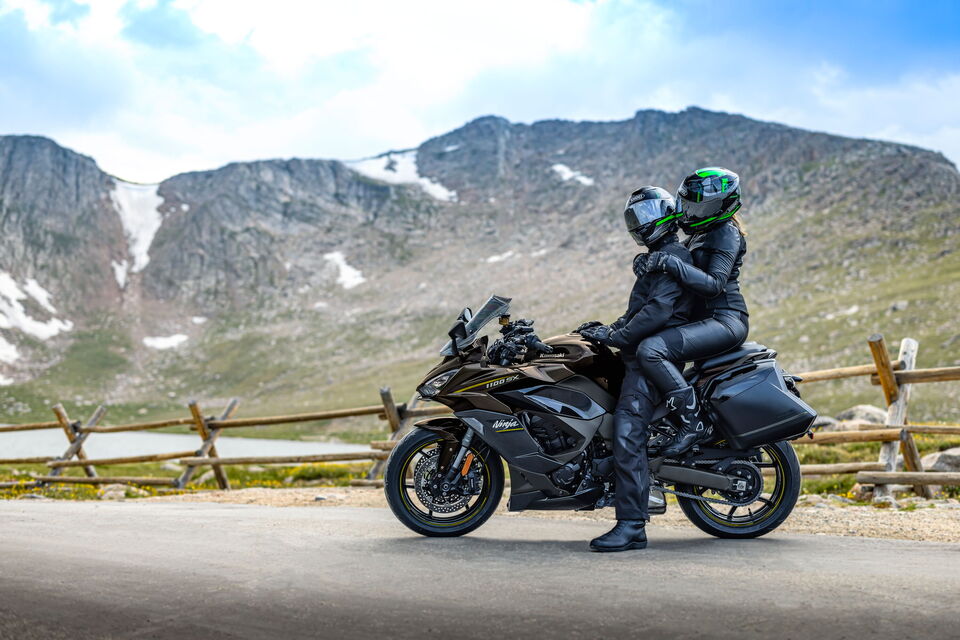
The Ninja 1100 SX riding position is deceptive. The motorcycle looks sleek and aggressive, yet the rider sits almost upright behind a comfortably high handlebar. An 835 mm seat height creates a moderate knee angle that remains comfortable on long stages. Tall riders fit well, and the passenger area is properly proportioned, with a clear view over the rider and useful grab handles. Riders sensitive to loading on the arms will find it reduced here, though not completely eliminated.
The windshield offers four positions, with one significant drawback: adjustment is possible only while stationary. You have to stop, operate the lever, and then continue. Wind protection itself is good. Kawasaki offers a larger touring screen as an accessory, roughly 30 mm taller and 60 mm wider on each side.
Cost: EUR 15,520 Including Destination—A Fully Equipped Sport-Tourer With Quickshifter and Cruise Control in the Middle of the Class
The Ninja 1100 SX costs EUR 15,520 including destination. Against the competition, it sits below the BMW S 1000 XR at around EUR 20,000, the Ducati Multistrada V4 at around EUR 21,000, and the Yamaha Tracer 9 GT+ at around EUR 16,000. Even against the new Honda CB1000GT at EUR 14,429, it remains competitively positioned. What distinguishes the Kawasaki at this price is that the electronics package—including bidirectional quickshifter, cruise control, IMU, and four riding modes—is standard where some rivals charge extra.
The SE costs EUR 1,650 more. That buys the Öhlins rear shock, Brembo M4.32 calipers, steel-braided brake lines, heated grips, and an integrated luggage system. The base model already delivers a complete sport-touring package with no fundamental omissions—just without the premium rear suspension, brakes, heated grips, and integrated luggage.
Verdict
The Ninja 1100 SX is a sport-tourer that convinces without showing off. Its engine is the main attraction: turbine-smooth, strong through the midrange, confident at the top, and silky through the quickshifter. The electronics package is complete, and the chassis contributes to the same sense of composure. The remaining flaws are minor but real: windshield adjustment requires a stop, and the four-cylinder is not entirely free of vibration between 6,000 and 8,000 rpm. Neither is a reason to walk away. They are simply part of making the buying decision with open eyes.
Quick Check
+ Turbine-smooth 1,099 cc inline-four: almost no abrupt load-change reaction or constant-throttle surging; outstanding long-distance engine.
+ Noticeably stronger low- and midrange than the previous 1000 SX: more passing punch and less need to downshift.
+ Bidirectional KQS standard from 1,500 rpm: one of the biggest improvements over the predecessor; works cleanly under virtually any load.
+ Cruise control standard: essential for long-distance use.
+ IMU-supported KIBS cornering ABS and lean-sensitive KTRC traction control standard.
+ Four riding modes—Sport, Road, Rain, Rider—standard; Rider mode allows individual mapping and KTRC settings.
+ KCMF coordinates braking force and engine output while cornering.
+ USB-C standard.
+ Fully adjustable 41 mm Showa USD fork with compression, rebound, and preload adjustment.
+ 235 kg ready to ride: surprisingly agile for the weight and easy to turn.
+ Bridgestone Battlax S23 standard: strong grip and quick warm-up.
+ Rideology app with voice commands; 4.3-inch TFT is easy to read.
+ Well-proportioned passenger accommodations and comfortable long-distance ergonomics.
+ Four-position adjustable windshield with good protection; larger touring screen available as an accessory.
+ Comprehensive factory luggage accessories: side cases and 47-liter top case with One-Key system.
+ EUR 15,520 including destination: complete sport-touring package priced below the Tracer 9 GT+ and BMW S 1000 XR.
+ 4-year warranty; Euro 5+.
– Vibration between 6,000 and 8,000 rpm through the hands and seat: reduced from the predecessor, but not eliminated.
– Windshield adjustment only while stationary: cannot be changed on the move.
– USB-C port installation looks somewhat crude.
– Riding-mode changes are awkward because the up/down buttons also control the trip computer and require a long press for mode selection.
– 4.3-inch TFT is functional but smaller than newer Kawasaki displays.
– No semi-active suspension as on the Versys 1100 SE or H2 SX SE; base model uses a conventional Showa rear shock.
– No heated grips as standard on the base model; available as an accessory.
– No integrated luggage system as standard on the base model; cases are accessories.
– 235 kg: tight parking maneuvers and very slow riding require experience.
– No angled tire valves as standard: a minor everyday annoyance when checking pressures.
– MY2026 is technically identical to MY2025: no suspension or electronics improvements.
Technical Specifications: Kawasaki Ninja 1100 SX (2026, Base)
Country of Manufacture: Japan, Kawasaki
Model Series: ZX1100H, 2025-present; MY2026 technically unchanged
Engine: Inline-four, 1,099 cc, liquid-cooled, DOHC; Ride-by-Wire; fuel injection; assist/slipper clutch; six-speed
Power: 136 hp at 9,000 rpm
Torque: 113 Nm at 7,600 rpm
Electronics: IMU; KIBS cornering ABS; KTRC lean-sensitive traction control; KCMF; bidirectional KQS from 1,500 rpm; four riding modes, Sport/Road/Rain/Rider; cruise control; KLCM
Display: 4.3-inch color TFT; Rideology app with voice commands; Bluetooth; USB-C standard
Frame: High-rigidity aluminum frame
Fork: 41 mm Showa USD; fully adjustable for compression, preload, and rebound; 120 mm travel
Rear Shock, Base: Showa; adjustable for rebound and preload
Front Brake, Base: Nissin four-piston monoblock calipers; dual 300 mm wave discs; KIBS
Rear Brake: Two-piston caliper; single disc; ABS
Wheels: 17-inch front and rear
Tires: 120/70 ZR17 front; 190/50 ZR17 rear; Bridgestone Battlax S23
Weight: 235 kg fully fueled
Seat Height: 835 mm
Wheelbase: 1,440 mm
Ground Clearance: 135 mm
Fuel Tank: 19 liters; approx. 327 km range; WMTC 5.6 L/100 km
Windshield: Four-position adjustable; only while stationary using lever, not while riding
Stationary Noise: Euro 5+; no official dB figure published
2026 Colors: Metallic Deep Blue / Metallic Diablo Black; Emerald Blazed Green / Metallic Diablo Black
SE Differences: Öhlins S46 rear shock instead of Showa; Brembo M4.32 with steel-braided lines instead of Nissin; heated grips standard; integrated luggage system standard
Accessories: Side cases with integrated One-Key system, 47-liter top case, larger touring windshield, heated grips, knee pads, seat cowl
Warranty: 4-year Kawasaki factory warranty
Service: Every 12,000 km
Price in Germany: EUR 15,520 including destination