Review Moto Guzzi V100 Mandello (2026)

115-hp Compact-Block V-Twin, Adaptive Aerodynamics, Shaft Drive, 233 kg—Guzzi’s First Liquid-Cooled Bike and the World’s First Sport-Tourer With Active Flaps
A liquid-cooled, longitudinally mounted 1,042 cc 90-degree Compact Block V-twin with DOHC, four valves per cylinder, Ride-by-Wire and Euro 5+. Output is 115 hp at 8,700 rpm and 105 Nm at 6,750 rpm, with 90 percent of torque available from 3,000 rpm. Six-speed transmission and shaft drive. A left-side aluminum single-sided swingarm, 41 mm Kayaba USD fork with 130 mm of travel, 130 mm rear monoshock, radial four-piston Brembo M4.32 front calipers on twin 320 mm discs, and six-axis-IMU cornering ABS. Adaptive aerodynamic flaps are standard, along with a 90 mm electrically adjustable windshield, four riding modes, cruise control, cornering lights and a 5-inch TFT. Quickshifter, TPMS, MIA connectivity and heated grips are optional on the standard model and standard on the V100 S. Ready-to-ride weight is 233 kg, seat height 815 mm, fuel capacity 17.5 liters. Price: EUR 15,699.
As of: April 18, 2026 | Model: Moto Guzzi V100 Mandello, standard version; V100 Mandello S covered separately | Production: Mandello del Lario, Italy | Price: EUR 15,699 | Colors: Ocean Blue, Titanium Gray
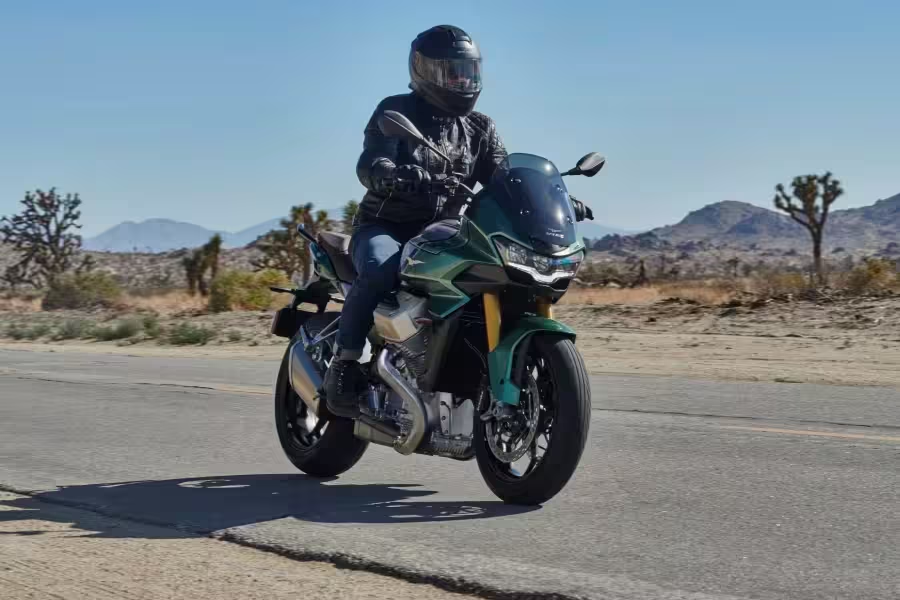
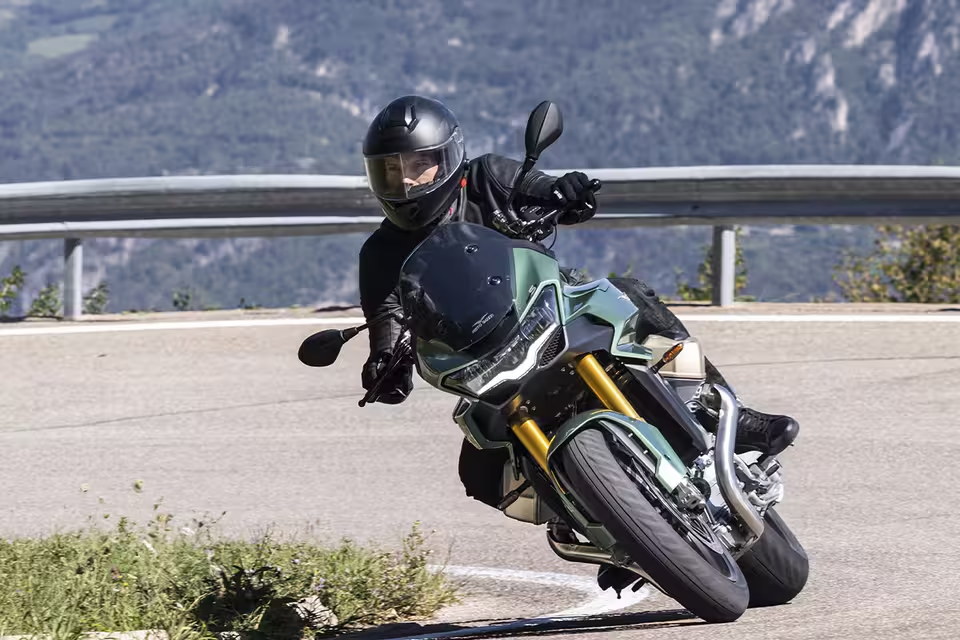
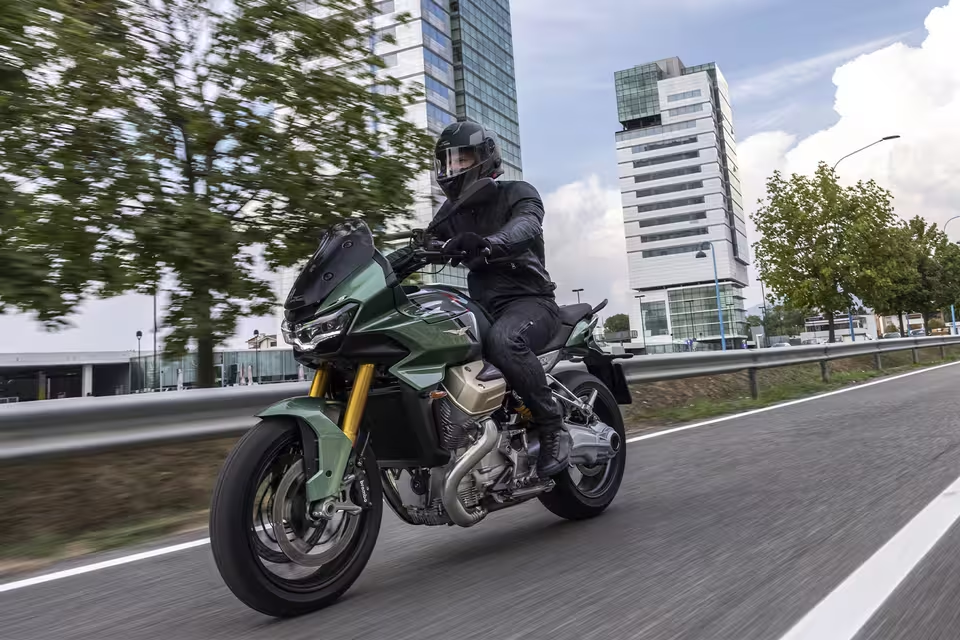
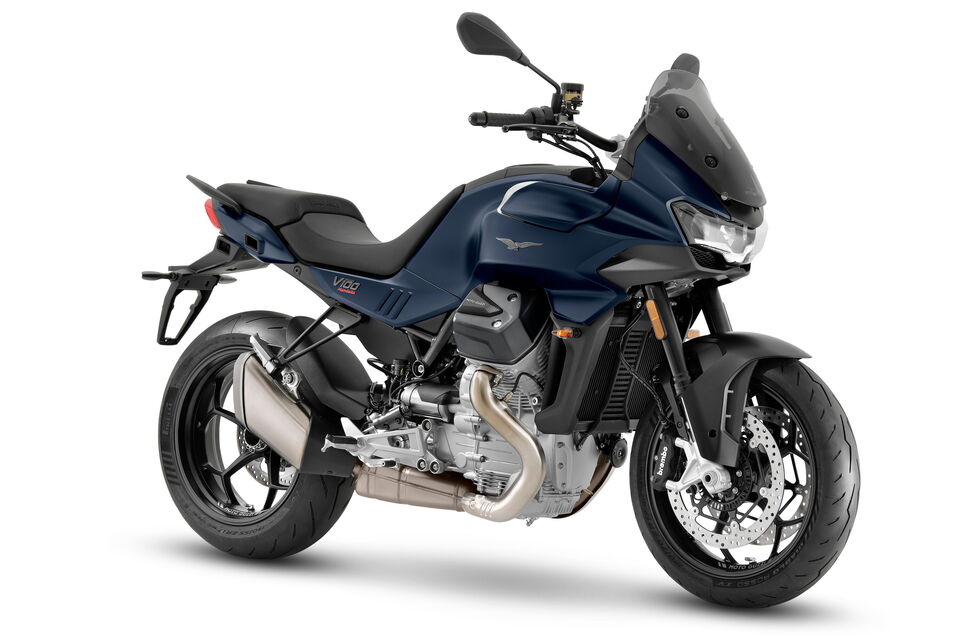
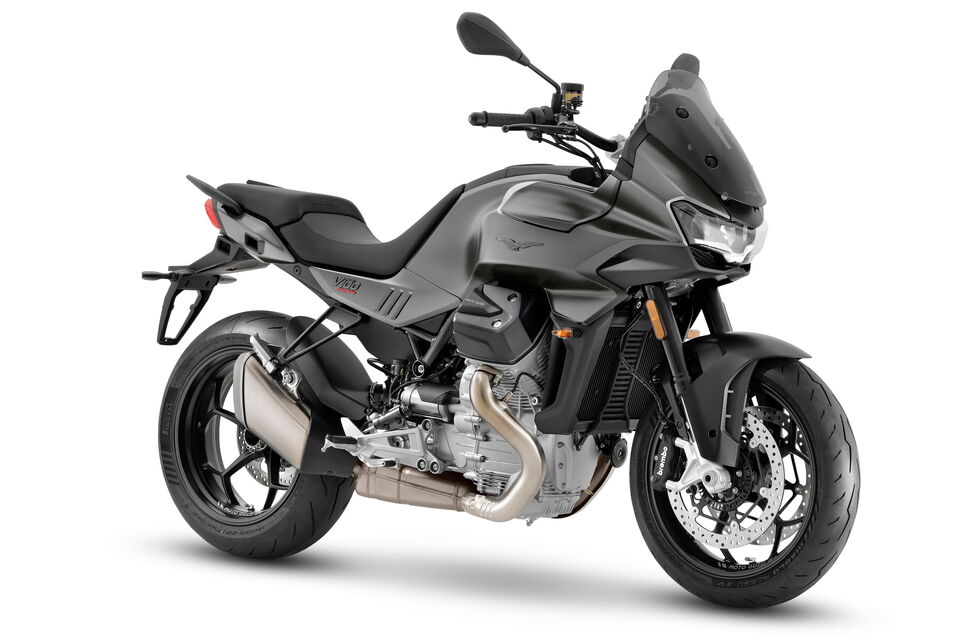
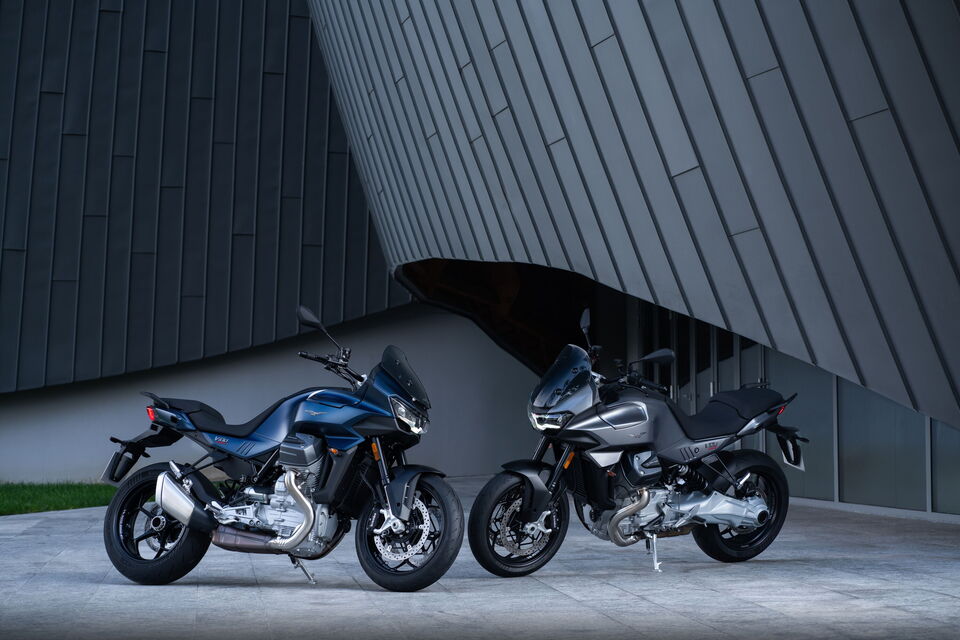
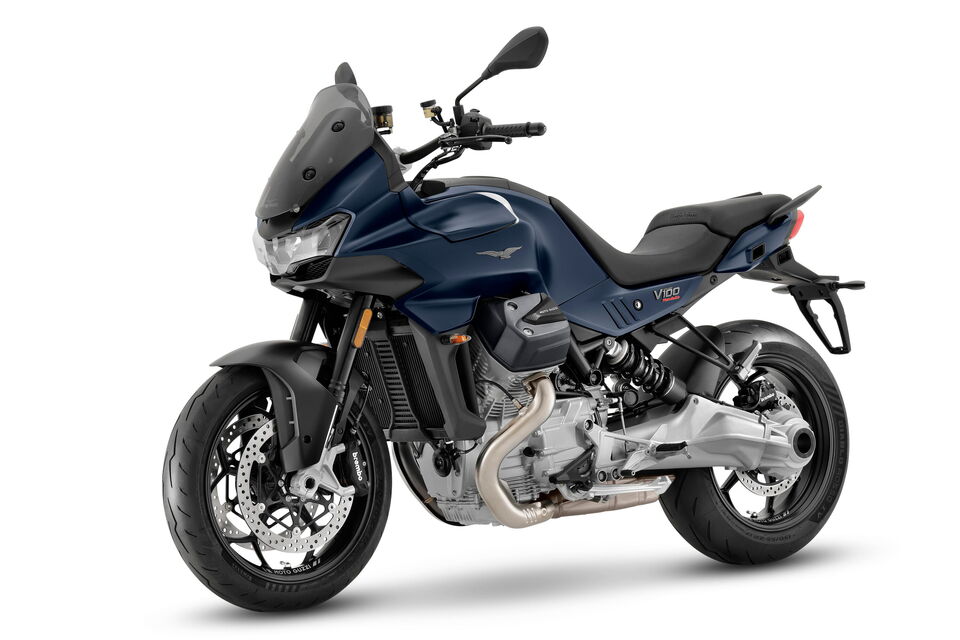
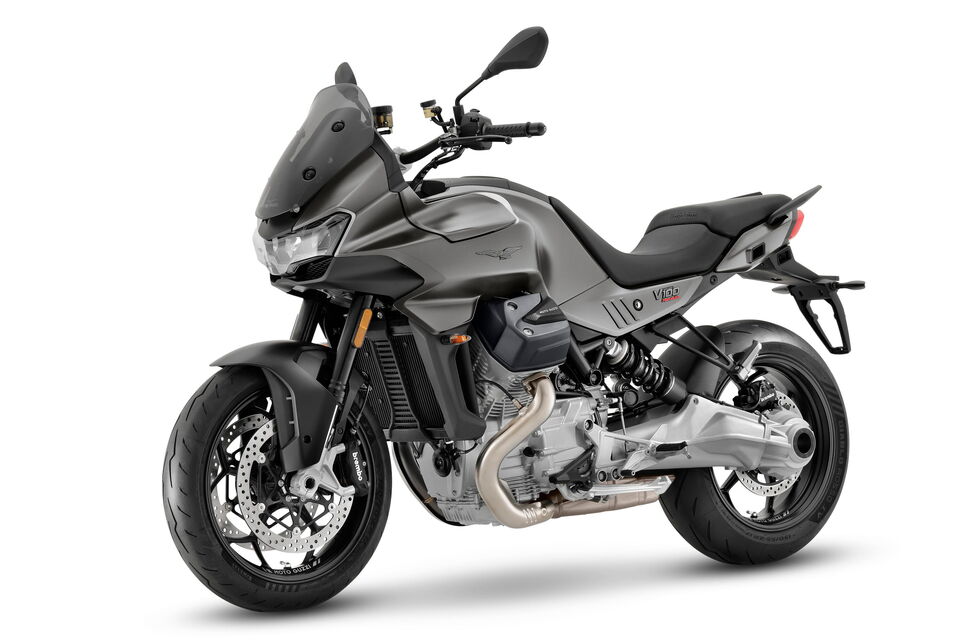

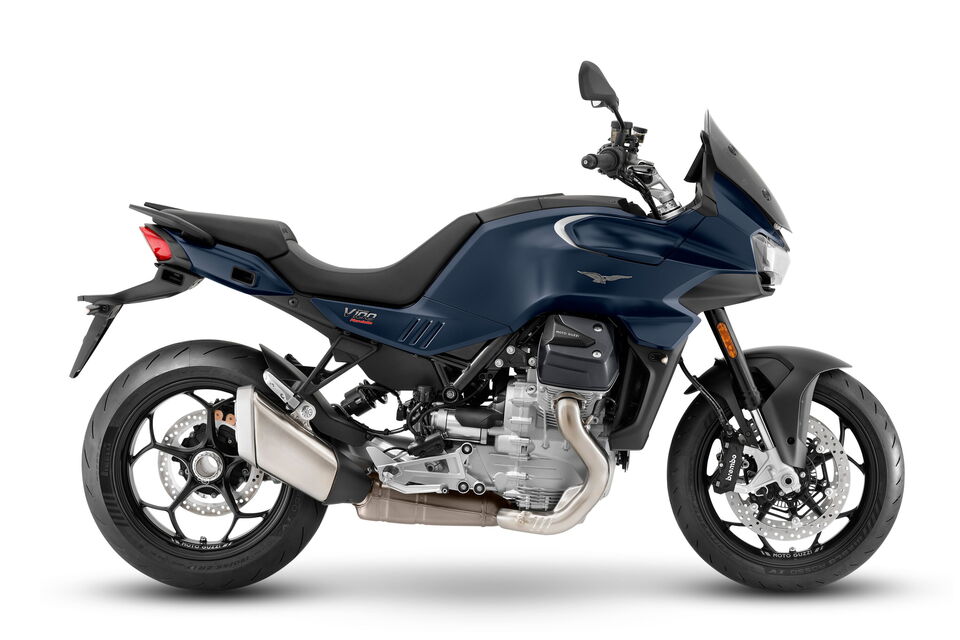
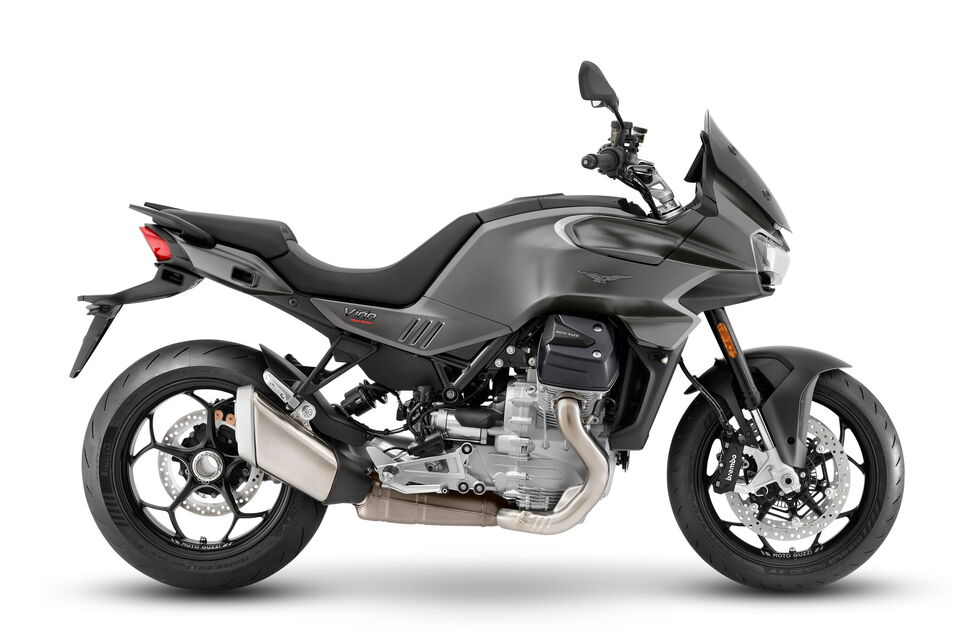
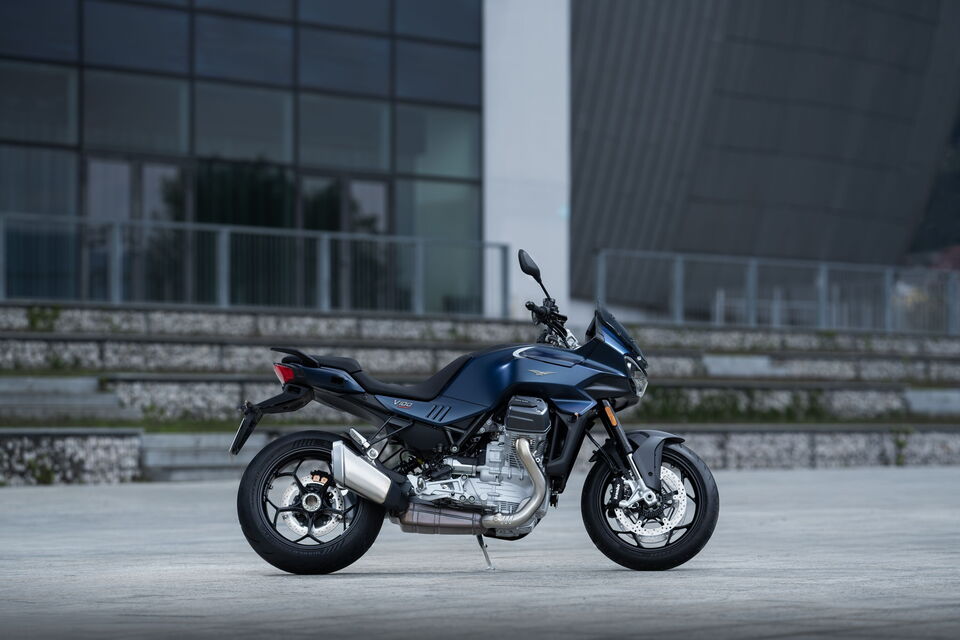


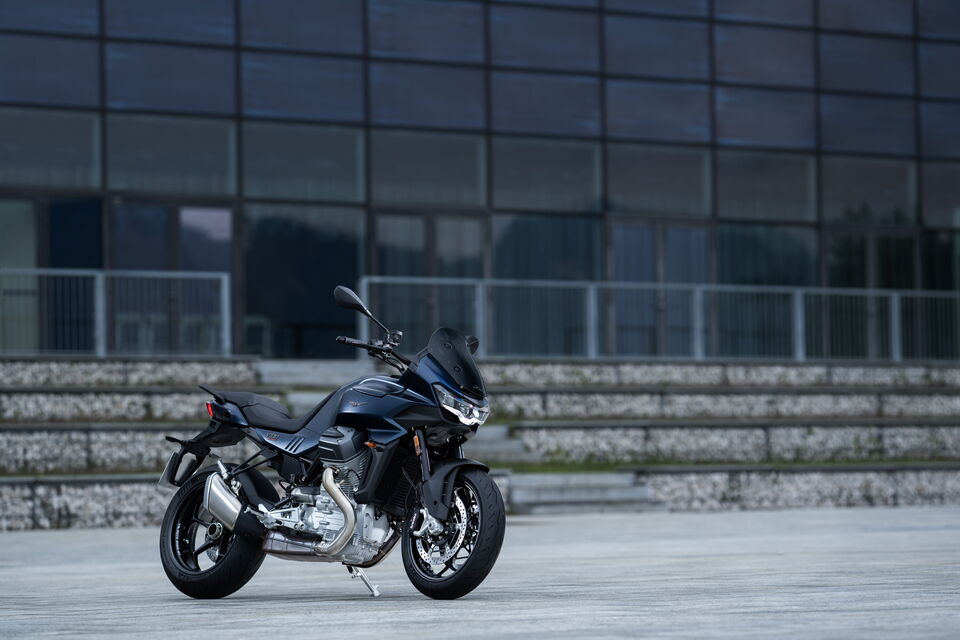
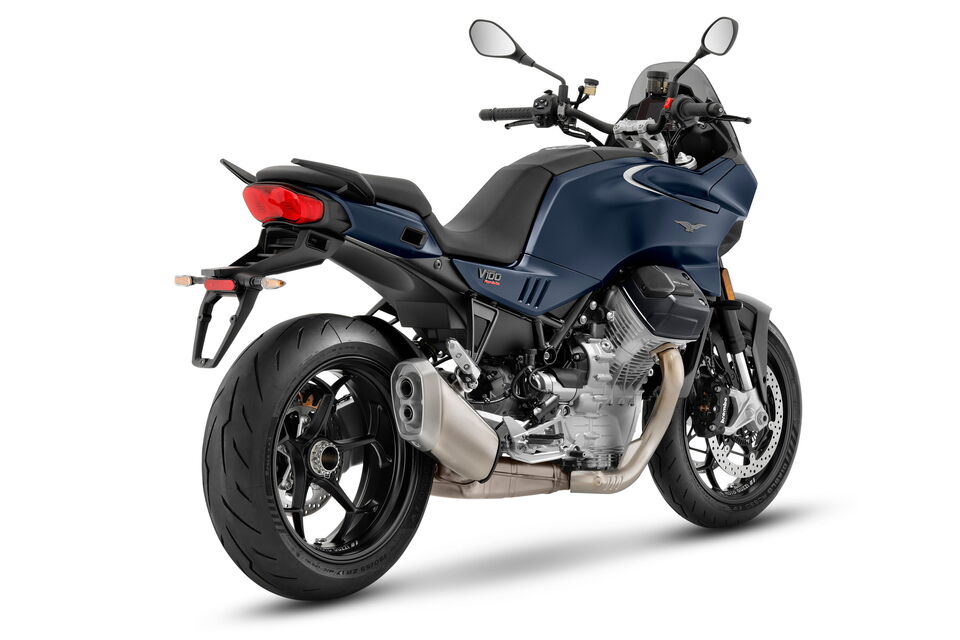
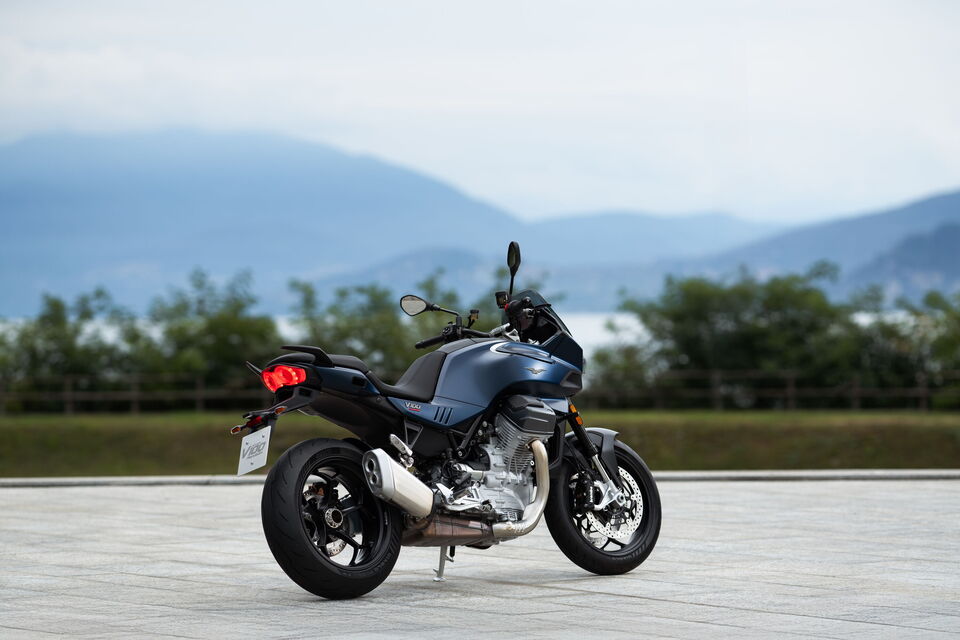
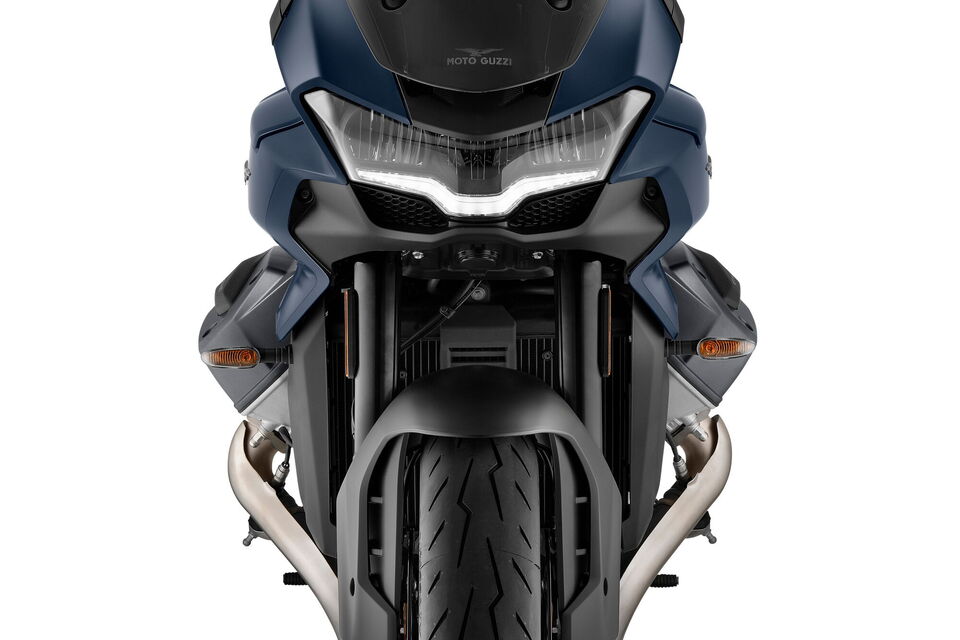

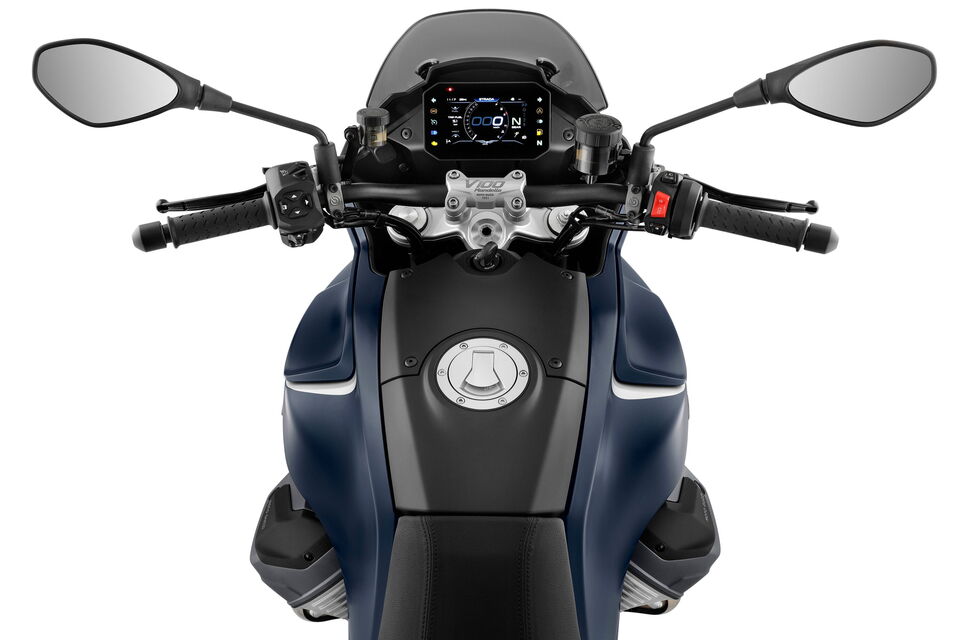
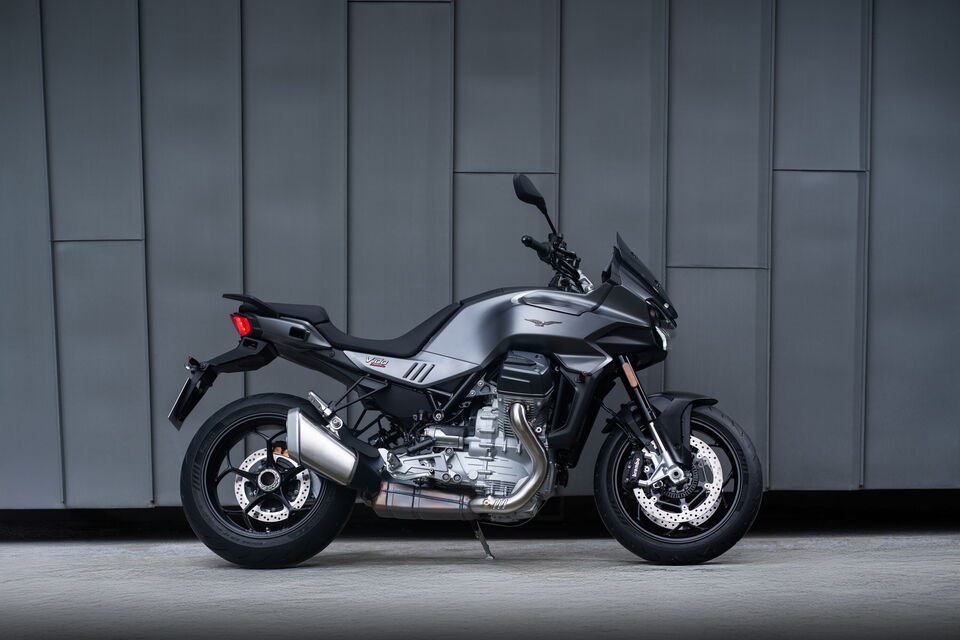



Pioneer Role: Moto Guzzi’s First Production Liquid-Cooled Engine—and, According to the Manufacturer, the World’s First Motorcycle With Adaptive Aerodynamics
The V100 Mandello marks the beginning of a new era for Moto Guzzi. Since 1921, the Mandello del Lario company had built exclusively air-cooled engines. The V100 breaks that tradition and brings Italy’s oldest continuously active motorcycle brand firmly into the modern technical age. But Moto Guzzi went further than simply adding liquid cooling. According to the manufacturer, the V100 was the first production motorcycle in the world equipped with adaptive aerodynamics. Side deflectors, or flaps, mounted alongside the fuel tank extend and retract electronically depending on speed and riding mode. This is not merely a styling exercise. Moto Guzzi has operated its own motorcycle wind tunnel since 1954, the first manufacturer-owned facility of its kind in the world.
Moto Guzzi positions the V100 as a roadster with genuine touring ability: sporty in riding position like a naked bike, but equipped technologically like a tourer. It deliberately combines two different personalities.
Engine: 1,042 cc Compact Block, DOHC, Liquid Cooling—115 hp, 105 Nm and Guttural V-Twin Character From 2,000 rpm
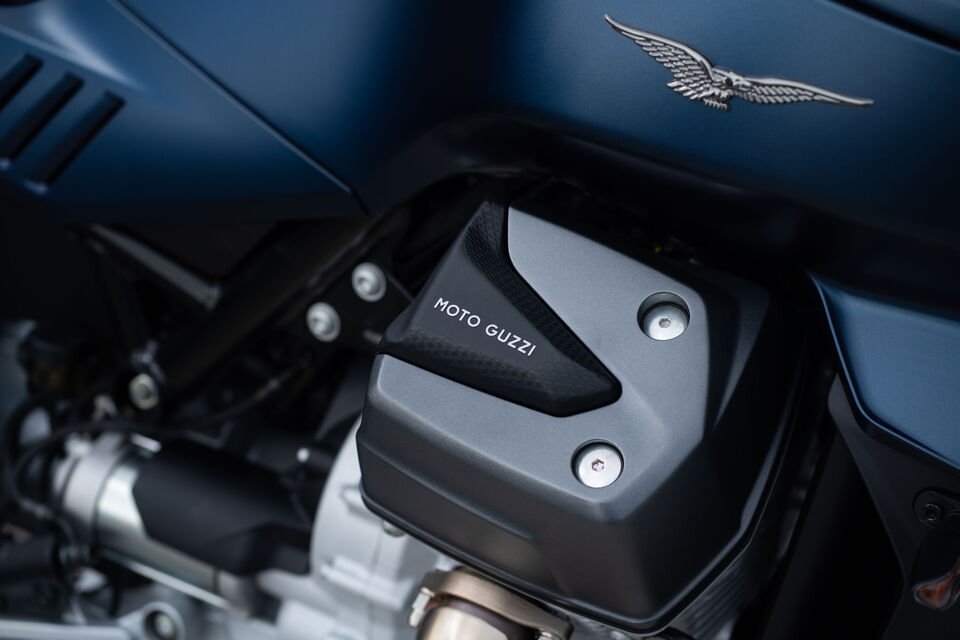
The Compact Block represents an entirely new engine generation. The longitudinal 90-degree V-twin uses liquid-cooled cylinder heads, DOHC valve gear with four valves per cylinder, and Ride-by-Wire. A balance shaft and slimmer crankshaft reduce vibration compared with older Guzzi engines. The engine block is 103 mm shorter than the V85 TT unit and serves as a stressed chassis member through six mounting points. The cylinder heads are rotated 90 degrees, with the intake ports facing upward and inward and the exhaust ports outward and downward. That creates more knee room and allows a straighter airflow path from top to bottom.
Output is 115 hp at 8,700 rpm and 105 Nm at 6,750 rpm, with 90 percent of peak torque available from 3,000 rpm. The engine will pull cleanly from 2,000 rpm without snatch, then delivers authoritative power from 3,000 rpm upward. The rev limiter intervenes gently at around 10,000 rpm, though the natural touring range sits well below that. The traditional Guzzi V-twin character—subtle rocking motion and a deep, rolling exhaust note—has been preserved. The engine meets Euro 5+ and consumes 5.1 L/100 km under WMTC.
Adaptive Aerodynamics: Flaps + Electric Windshield—Individually Configurable, Riding-Mode Controlled, Activation Threshold Adjustable From 30 to 90 km/h
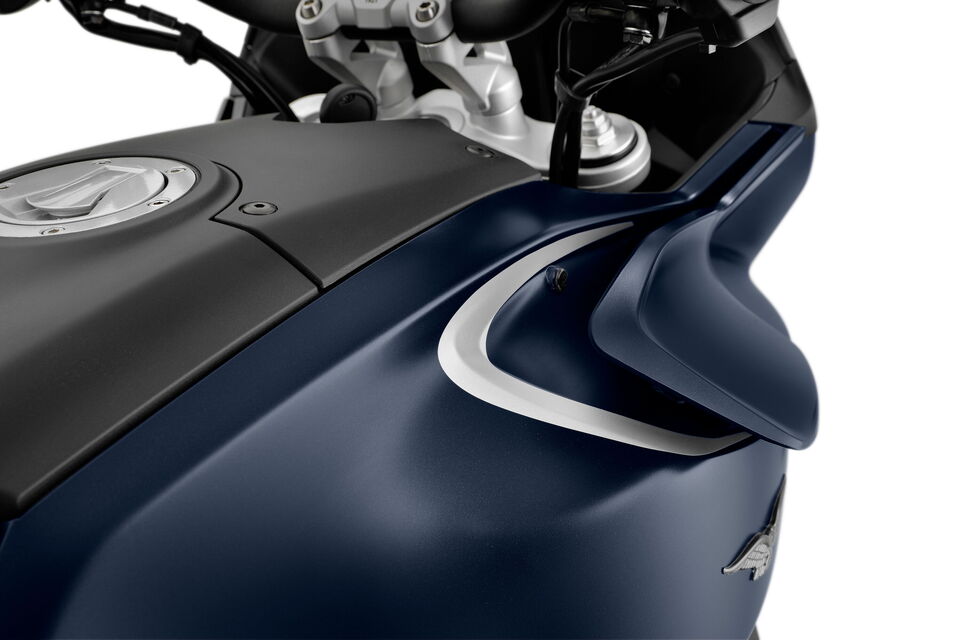
The V100’s aerodynamic system has two components: tank-mounted side flaps and an electrically adjustable windshield with 90 mm of travel. By default, the flaps deploy automatically according to riding mode. In Pioggia mode they remain permanently active; in Turismo they deploy from 70 km/h; in Sport and Strada they remain retracted. These settings can be customized completely. The rider can choose an activation speed anywhere between 30 and 90 km/h, keep the flaps permanently extended, or switch them off entirely—and configure those choices separately for each riding mode.
In practice, the system works. With the flaps extended, wind and rain are directed away from the rider’s torso at higher speeds. The electrically adjustable windshield complements them. Together, the two systems provide unusually effective weather protection for a motorcycle with an upright roadster riding position.
Chassis: Kayaba USD, Radial Brembo M4.32, Left-Side Aluminum Single-Sided Swingarm—Remarkably Light-Feeling Despite 233 kg
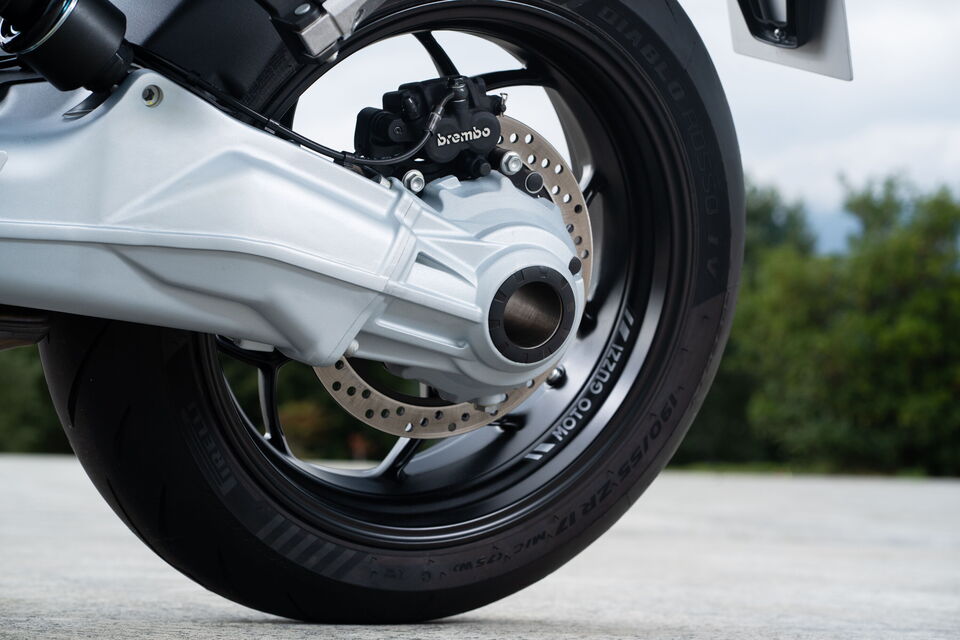
The standard model uses Kayaba suspension. Up front is a 41 mm USD fork with 130 mm of travel, manually adjustable for spring preload and rebound damping. At the rear is a 130 mm monoshock with handwheel preload adjustment and adjustable rebound. The aluminum single-sided swingarm sits on the left side—another Moto Guzzi first and a technical consequence of the new shaft-drive layout.
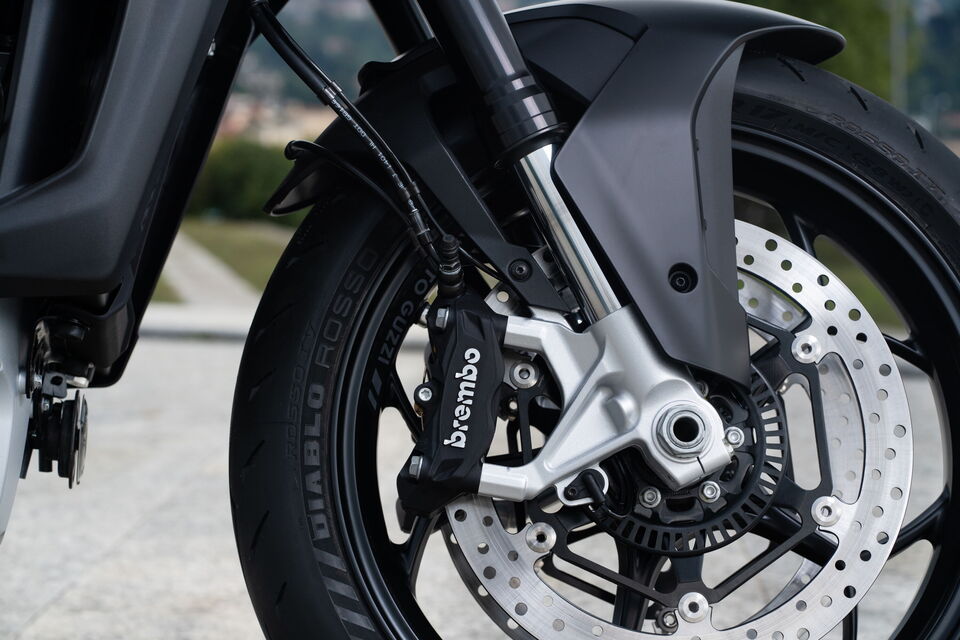
Braking is handled by radial four-piston Brembo M4.32 calipers on twin 320 mm front discs, with a 280 mm rear disc and two-piston floating caliper. Steel-braided brake lines and six-axis-IMU cornering ABS are standard. Lever effort is low, modulation is clean, and stopping performance is strong.
Handling is the real surprise. The V100 feels crisp and unexpectedly eager through S-bends despite a 233 kg ready-to-ride weight. The reasons are straightforward: a favorable center of gravity from the low Compact Block engine, a wide handlebar with plenty of leverage, and a naked-bike-style riding position. Easy, low-effort cornering is one of the motorcycle’s strongest qualities.
Ergonomics: 815 mm, 233 kg, Roadster Riding Position—Upright, Wide-Barred and Suitable for a Broad Range of Riders
An 815 mm seat height is moderate for a sport-tourer in this class. The riding position is considerably more upright than on traditional sport-tourers: more naked bike, less long-distance race crouch. That improves everyday comfort and makes active cornering easier, although it gives away some natural highway wind protection. The flaps and electrically adjustable windshield compensate effectively. The ergonomics also work well for riders outside the average height range.
The 17.5-liter tank is smaller than the V85’s 23-liter unit but adequate for the V100’s sport-touring mission. At 5.1 L/100 km under WMTC, realistic range is roughly 300 to 340 km. The source lists a gross vehicle weight of 443 kg, allowing useful luggage capacity. A luggage rack and 28/32-liter plastic side cases are available as accessories. A USB port in the cockpit costs extra; the standard power connection is located beneath the passenger seat.
Standard vs. S: What the Base Version Does Without—and Why Many Riders Will Not Care
The standard V100 Mandello differs from the V100 S in four major areas. It uses manually adjustable Kayaba suspension instead of semi-active Öhlins Smart EC 2.0, the quickshifter is optional rather than standard, and heated grips, TPMS, and MIA smartphone connectivity are also extra-cost items. Adaptive aerodynamics, cornering ABS, traction control, cruise control, cornering lights, the 5-inch TFT, and the electrically adjustable windshield are standard on both versions.
The standard model therefore gives up semi-active suspension, the factory-installed quickshifter, heated grips, tire-pressure monitoring, and connectivity in exchange for a substantial saving. For riders who mainly care about the engine, shaft drive, adaptive aerodynamics, and core safety electronics, the base version is the rational choice.
Cost: EUR 15,699—Sport-Tourer With Shaft Drive, Adaptive Aerodynamics and Cornering ABS as Standard
EUR 15,699 is the reference price for the standard version, while the S costs roughly EUR 3,300 more according to the source. In the broader sport-touring segment, a BMW S 1000 XR starts around EUR 20,000 and a Ducati Multistrada V4 around EUR 21,000. The V100 is the less expensive option in the premium sport-touring field and, alongside the BMW R 1300 RS, one of only two 900–1300 cc sport-tourers with shaft drive cited in the source. With adaptive aerodynamics, the V100 remains unique.
One important caveat concerns depreciation. Used V100 Mandellos have shown weak price stability. Early MY2022 examples have lost substantial value, with low-mileage bikes sometimes advertised around EUR 12,000. Buyers who are flexible about model year can therefore find significant savings on mechanically similar used machines.
Verdict
The V100 Mandello is the technically boldest motorcycle Moto Guzzi has ever built: the brand’s first production liquid-cooled engine, the first adaptive aerodynamics on a production motorcycle according to Moto Guzzi, and the company’s first cornering ABS. Yet it remains unmistakably a Guzzi: a longitudinal 90-degree V-twin, shaft drive, Italian temperament, and a deep, rolling character. The standard model is the rational choice. Adaptive aerodynamics, cornering ABS, and cruise control are included, which covers the essentials for most riders.
Quick Check
+ Moto Guzzi’s first production motorcycle with a liquid-cooled engine—the beginning of a new technical era for the brand.
+ Adaptive aerodynamic flaps standard: according to Moto Guzzi, the first production motorcycle in the world with this feature.
+ 90 mm electrically adjustable windshield plus flaps provide excellent wind protection for a roadster-style riding position.
+ Shaft drive: one of only two 900–1300 cc sport-tourers with shaft drive cited in the source, alongside the BMW R 1300 RS.
+ 115 hp and 105 Nm: clean pull from 2,000 rpm, authoritative midrange, and characteristic V-twin feel.
+ Radial Brembo M4.32 front calipers on twin 320 mm discs plus six-axis IMU: cornering ABS and traction control standard.
+ Handling feels light and agile despite 233 kg weight.
+ Four riding modes are highly configurable, including separate flap activation settings for each mode.
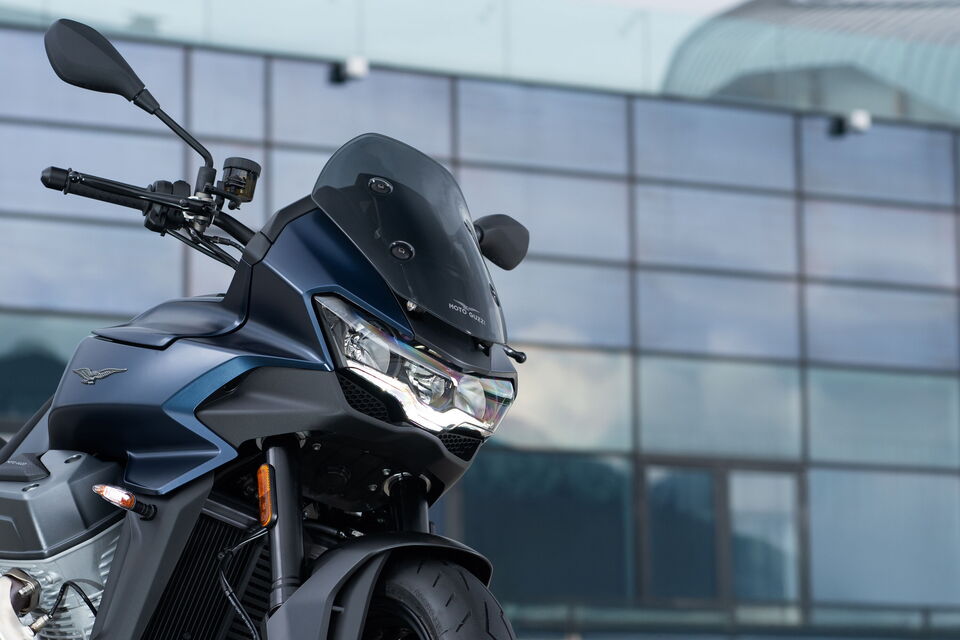
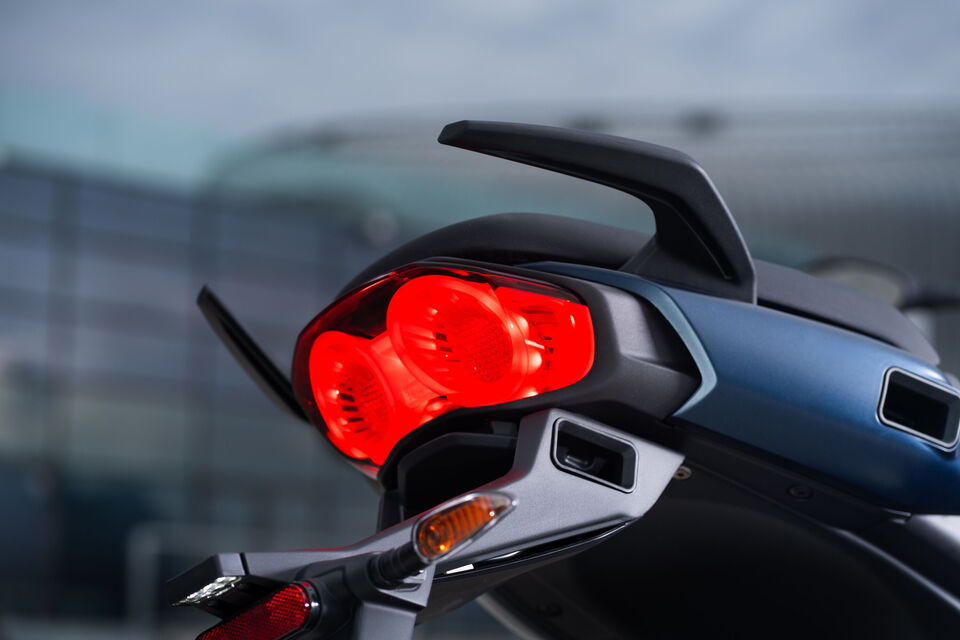
+ Cruise control, cornering lights, 5-inch TFT, and full LED lighting standard on the base model.
+ 815 mm seat height: moderate; naked-bike-style riding position works across a broad range of rider heights.
+ Left-side aluminum single-sided swingarm: new construction and a Moto Guzzi first.
– 17.5-liter tank: roughly 300–340 km range, significantly less than the V85 TT’s 23-liter capacity.
– Quickshifter is optional on the standard model; source notes that upshifts on test bikes could be somewhat unsettled.
– Cockpit USB port costs extra; standard power outlet is beneath the passenger seat.
– Automatic turn-signal cancellation operates late.
– Heated grips, TPMS, and MIA connectivity are optional on the standard model and standard only on the S.
– Standard Kayaba suspension is manually adjusted and lacks the V100 S’s semi-active Öhlins system.
– 233 kg: not a lightweight.
Technical Specifications: Moto Guzzi V100 Mandello (2026)—Standard Version
Brand / Production: Moto Guzzi, Piaggio Group; Mandello del Lario plant, Lake Como, Italy; deliveries began late 2022 / early 2023
Engine: Compact Block longitudinal 90-degree V-twin, 1,042 cc, liquid-cooled, DOHC, four valves per cylinder; 96 x 72 mm bore and stroke; 12.6:1 compression; Ride-by-Wire; balance shaft; wet-sump lubrication; Euro 5+; six-speed; shaft drive; engine as stressed member through six mounting points
Power: 115 hp / 84.6 kW at 8,700 rpm; rev limiter around 10,000 rpm
Torque: 105 Nm at 6,750 rpm; 90 percent available from 3,000 rpm
Frame: Steel-tube twin-spar frame; engine as stressed member; left-side aluminum single-sided swingarm, a Moto Guzzi first
Fork, Standard: 41 mm Kayaba USD; manually adjustable spring preload and rebound damping; 130 mm travel
Rear Shock, Standard: Monoshock; handwheel preload adjustment and adjustable rebound; 130 mm travel
Difference vs. S: V100 S: semi-active electronic Öhlins Smart EC 2.0 with four modes. Standard: manually adjustable Kayaba suspension
Front Brake: Radial four-piston Brembo M4.32 Monobloc calipers; twin 320 mm semi-floating discs; cornering ABS; steel-braided lines
Rear Brake: 280 mm disc; Brembo two-piston floating caliper; cornering ABS
Aerodynamics: Adaptive tank flaps standard; individually configurable 30–90 km/h activation threshold for each riding mode; electrically adjustable windshield with 90 mm range standard
Electronics: Six-axis IMU; cornering ABS; adjustable and switchable traction control; four riding modes: Turismo / Strada / Sport / Pioggia; cruise control standard; cornering lights standard
Standard-Model Options: Bidirectional quickshifter; TPMS; MIA Bluetooth/smartphone connectivity; heated grips; cockpit USB; prepared for radar BLIS/LCA
Wheels: Lightweight aluminum; 3.50 x 17 front / 6.00 x 17 rear
Tires: 120/70-17 front / 190/55-17 rear
Cockpit: 5-inch color TFT; full LED lighting including DRL, cornering lights and turn signals; MIA optional
Weight: 233 kg fully fueled
Seat Height: 815 mm
Fuel Tank: 17.5 liters; approx. 300–340 km range
Fuel Consumption: 5.1 L/100 km WMTC
Payload: 210 kg
German Price: EUR 15,699 standard; V100 S approx. EUR 3,300 more