At the Limit? Why the Adventure Boom Keeps Rolling – While the Big Beasts Are Running Out of Room
Too heavy, too expensive, too much motorcycle? Hardly a conversation at a bike hangout goes by these days without those three accusations being aimed at the modern adventure bike. Parking lots are packed with tall, do-it-all machines, flagship prices are brushing the EUR 30,000 mark – and manufacturers keep adding more. So has the adventure category reached its peak?
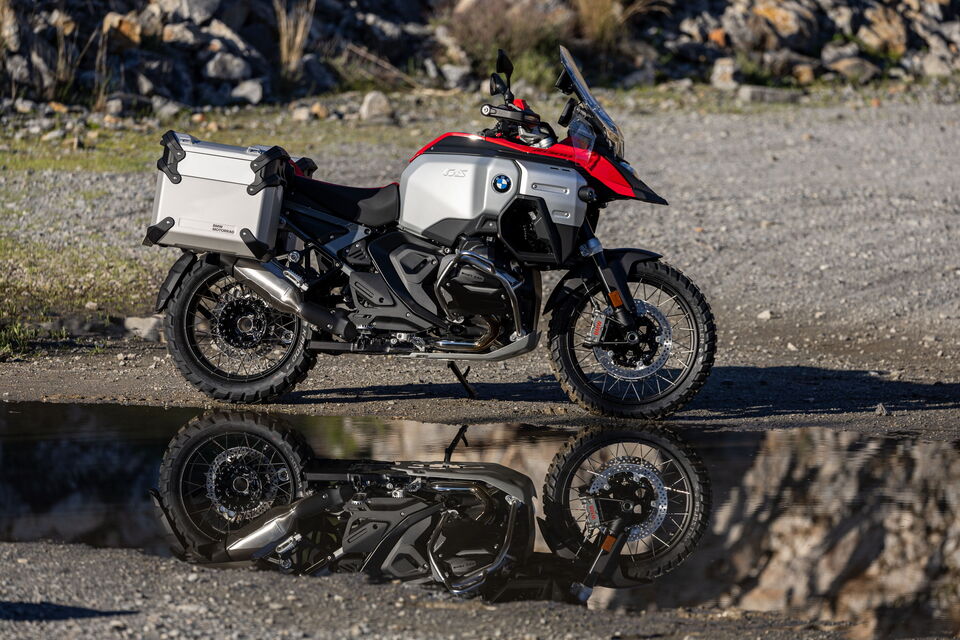
The sober answer: adventure bikes are still booming – just not equally strongly everywhere.
Numbers Versus Gut Feeling
Look only at Western Europe and it is easy to get the impression that the market is saturated. New registrations have clearly normalized after the unusually strong pandemic years. Globally, however, the picture points in another direction: industry forecasts still expect annual adventure-bike growth of roughly five to seven percent into the 2030s.
Manufacturers provide hard evidence as well. BMW Motorrad has again reported record sales, and the GS family continues to account for a huge share of its total volume. There is no sign of a collapse.
In short, the market is still growing – just no longer with the force of the boom years.
Why It Still Feels Like ‘Peak Adventure’
The fact that many riders feel otherwise is not imaginary.
An Endless Flood of Models
A little over 15 years ago, the field was easy to understand: GS, Africa Twin, Tiger, KTM Adventure. Today, virtually every manufacturer offers several adventure bikes across multiple displacement classes. New brands from China and India are piling in as well. That creates a feeling of oversupply even while global demand continues to rise.
Premium-Level Prices
A fully equipped large adventure bike now easily costs as much as a small car. That inevitably puts natural limits on growth. Not everyone who likes an upright riding position wants – or can afford – to spend more than EUR 25,000.
The Weight Debate Is Getting Louder
Ready-to-ride weights beyond 250 kg are now more rule than exception in the flagship class. Tests and rider forums therefore raise the same question with increasing frequency: do you really need that much motorcycle for normal touring?
The Segment That Really Is Close to Its Peak
Look more closely and a clear picture emerges: the category closest to saturation is the large premium adventure-bike segment above 1,200 cc.
The reasons are tangible:
· Prices have reached a natural ceiling.
· The core European target group is already largely developed.
· Replacement purchases increasingly substitute for genuinely new customers.
· Further technical escalation offers only limited additional value to many riders.
One point matters: this class remains highly profitable and hugely important for brand image. Its growth potential, however, is limited.
The Real Action Is One Level Down
While the heavyweight flagships move into maturity, the real momentum is developing below them. Middleweight adventure bikes between roughly 400 and 900 cc are becoming the category’s quiet growth engine.
Why?
· significantly lower entry prices
· A2 compatibility for younger riders
· noticeably less weight
· strong everyday usability
· high demand in emerging markets
The pattern is hard to miss: virtually every major manufacturer is expanding its strategy in exactly this displacement range. New sub-liter platforms are appearing one after another. In the motorcycle industry, that is usually a pretty reliable early indicator.
Where the Category Is Heading
Everything suggests that adventure bikes are not heading for a crash, but for a reshuffle. The next few years are likely to be defined by:
· greater segmentation instead of one universal flagship
· a growing role for the middleweight class
· lighter, more off-road-focused concepts
· more competition from new manufacturers
· cautious early experiments with electric power
The big adventure bike will remain the emotional flagship – but it will no longer be the category’s only growth engine.
Verdict
The adventure boom is not over. Globally, the segment continues to grow at a solid pace and remains one of the pillars of the motorcycle market.
What is becoming increasingly clear is that the era of the ever-larger, heavier, and more expensive adventure flagship is approaching its natural saturation point. The future of the category will be broader, lighter, and more accessible.
Put plainly:
Adventure bikes are not at the limit – only the biggest ones are.