Is Harley-Davidson Screwed? How America's Greatest Motorcycle Brand Became a Prisoner of Its Own Success
Harley-Davidson has something almost every motorcycle manufacturer on earth would kill for: a name known by people who couldn't tell a crankshaft from a kickstand. It has history, mythology, dealers, clubs, tattoos, movies, merchandise, and one of the most loyal customer bases in motorcycling. And that may be exactly the problem. Harley spent decades building the perfect motorcycle for the Harley rider. Unfortunately, the Harley rider got old. Now Milwaukee faces an uncomfortable question: What happens when your most loyal customers won't accept change – but aren't buying enough motorcycles anymore?
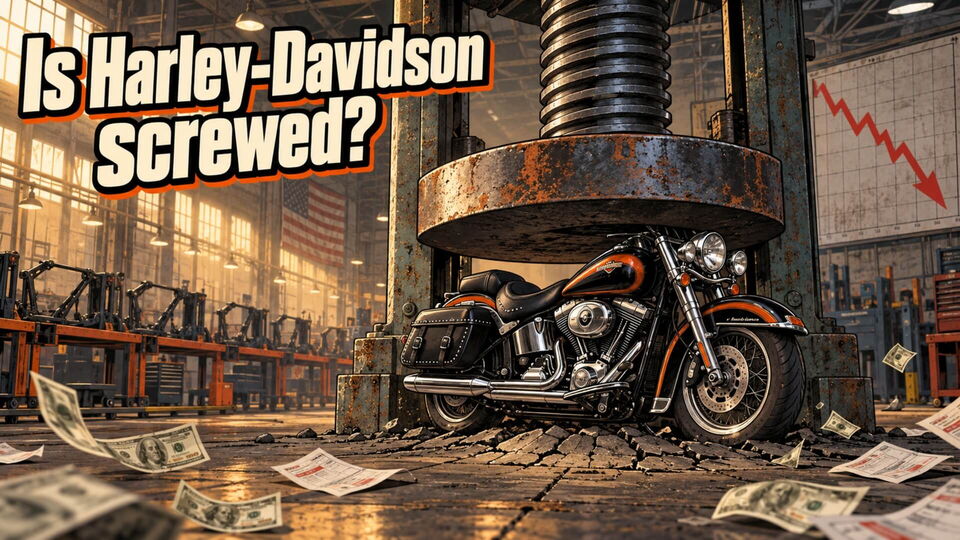
Harley-Davidson isn't dead. Let's get that out of the way first. Dead companies don't sell more than 130,000 motorcycles a year. Dead companies don't generate more than a billion dollars in motorcycle revenue in a quarter. Dead brands don't have customers tattooing their logos onto their bodies. And the most recent numbers actually contain some good news. After a miserable 2025, U.S. retail sales rose again in the first half of 2026.
So no, Harley-Davidson isn't the Titanic after the bow has disappeared beneath the Atlantic. But there may already be water below deck. And the band is still playing.
Harley's Greatest Achievement Became Its Greatest Problem
To understand Harley's predicament, you have to go back to the years when everything worked. Harley-Davidson did something extraordinary in the 1980s and '90s: It stopped selling motorcycles and started selling Harley-Davidson.
That sounds like marketing nonsense, but it wasn't. The motorcycle became only one part of the product. You bought the bike, then the jacket, the boots, the exhaust, the chrome, the Screamin' Eagle parts. You joined H.O.G., went to Sturgis, and eventually bought another Harley. At some point, Harley-Davidson wasn't simply something parked in your garage anymore. It was who you were.
Few motorcycle manufacturers have ever achieved that. Honda customers like Hondas. BMW riders may love BMWs. Ducati owners can become mildly religious about Ducati. But Harley created a tribe. And tribes are wonderful for business – until they become border patrol.
The Customer Became the Product Manager
This may be Harley-Davidson's deepest problem. For decades, the company trained its customers to believe that a real Harley had to be a certain thing: a V-twin, heavy, low, long, American, traditional, preferably covered in chrome, and ideally producing a soundtrack capable of triggering car alarms three blocks away.
That formula was enormously successful, so Harley kept feeding it. More cruisers, more touring bikes, more displacement, more torque, more equipment, more weight, more money. The customers applauded. The accountants applauded. The dealers applauded. And Harley became incredibly good at selling increasingly expensive variations of the same fundamental idea to increasingly affluent versions of the same fundamental customer.
That wasn't stupidity. It was exactly what successful companies normally do: maximize what works. The trouble begins when yesterday's strength becomes tomorrow's dependency.
Then Harley Tried Something Different
And this is where the story gets almost tragic, because Harley actually saw the problem coming.
Buell was different. Too different, apparently. Erik Buell tried to prove that an American motorcycle could corner, brake, innovate, and compete with European and Japanese sport bikes while still possessing a distinctly American identity. Buells were weird. Some were brilliant, some were flawed, but they represented something Harley desperately needed: another definition of what an American motorcycle could be. Eventually, Buell disappeared from Harley's universe.
Then came LiveWire. An electric Harley? To part of the traditional audience, that sounded roughly equivalent to alcohol-free Jack Daniel's.
Then came the Pan America. An adventure bike from Harley-Davidson, with liquid cooling, serious horsepower, modern electronics, long suspension travel, and – horror of horrors – respectable cornering clearance. Once again, the reaction from parts of the faithful was predictable: That's not a Harley.
And therein lies the trap.
If Everything New “Isn't a Harley,” What Happens When the Old Harley Customer Disappears?
That question should probably be written in six-foot letters somewhere in Milwaukee, because this isn't really a motorcycle problem. It's a demographic problem.
Harley's traditional American customer base is aging. That doesn't mean every Harley rider is old, overweight, gray-haired, and wearing a sleeveless T-shirt while explaining why removing a muffler is a constitutional right. That's the caricature. But caricatures become dangerous when they contain enough truth to define the public image of a brand.
Ask a 25-year-old non-motorcyclist what a Harley rider looks like. Then ask the same person what a Yamaha MT-07, KTM, or Ducati rider looks like. Harley has an image problem before the young customer even walks into the dealership. The motorcycles look expensive, heavy, and intimidating. And to many young people, they look like something their father – or grandfather – would ride.
That isn't where a youth problem ends. It's where it begins.
The Numbers Aren't Pretty
The long-term sales trend is difficult to ignore. Harley-Davidson sold 194,256 motorcycles worldwide in 2021. By 2025, that figure had fallen to 132,535. In the United States, sales dropped from 126,276 to 82,698 over the same period.
That isn't a bad quarter, bad weather, or one unpopular model. It's structural erosion. And 2025 was particularly ugly: worldwide retail sales fell 12 percent, North America fell 13 percent, Europe, the Middle East, and Africa fell 11 percent, and Asia-Pacific fell 15 percent.
Then something interesting happened. In the first half of 2026, U.S. sales rose 8.5 percent and worldwide sales increased 3.7 percent. That's good news, obviously. But look more closely and the picture becomes less reassuring. Harley says the U.S. improvement was driven primarily by its Grand American Touring motorcycles, including refreshed Trikes and models supported by incentives.
In other words, the recovery is being driven largely by the very heart of traditional Harley-Davidson. That helps today's income statement. It doesn't necessarily solve tomorrow's customer problem.
More Roads Wasn't Crazy. It Was Probably Necessary
This is what makes Harley's abandoned “More Roads to Harley-Davidson” strategy so fascinating. Announced in 2018, the plan was wildly ambitious. Harley wanted millions of new American riders, dramatically more international business, 100 new high-impact motorcycles, middleweights, small-displacement machines for emerging markets, and leadership in electric motorcycles.
Read that list today and it sounds less like corporate madness than a diagnosis. Harley knew exactly what was wrong: too dependent on America, too dependent on heavyweight motorcycles, too dependent on existing riders. Not enough young customers, not enough entry points, not enough relevance in emerging markets.
The strategy wasn't perfect. It was probably too broad, too expensive, and too ambitious. But the fundamental idea was right: There had to be more roads to Harley-Davidson because the old road was getting narrower.
Then the strategy changed. Harley refocused and the core became king again. In the short term, that made sense because the core customers were where the money was. The problem is that short-term profitability and long-term survival are not always the same thing.
Asia Exposes the Contradiction
Nowhere is Harley's problem more obvious than in Asia. Imagine telling a 24-year-old rider in India that the future of motorcycling is an 800-pound American touring motorcycle costing the equivalent of a small apartment. Good luck.
The motorcycle markets with the greatest volume potential don't necessarily want traditional American heavyweight motorcycles. They want accessible, affordable bikes that work in dense cities, bikes that don't require a reverse gear and a gym membership to get out of a parking space.
Harley actually has an answer. The X440, developed with Hero MotoCorp for India, is a 440cc single-cylinder Harley aimed at an entirely different customer. And something remarkable happened when it appeared: People wanted it. More than 25,000 customers placed orders during its first month of bookings.
Think about that for a second. A smaller, cheaper Harley-Davidson designed for an emerging market didn't destroy the brand. It attracted customers. Funny how that works.
The problem is that motorcycles such as the X440 still feel like satellites orbiting the Harley-Davidson mother ship rather than the center of a coherent global product strategy.
LiveWire Shows the Other Extreme
Then there is LiveWire. Harley's electric adventure was courageous. Commercially, it has so far been tiny. LiveWire sold 653 electric motorcycles in 2025. Six hundred fifty-three. Harley-Davidson's electric future currently fits comfortably into the parking lot at a decent-sized rally. And the LiveWire business lost $75 million in 2025.
That doesn't mean electric motorcycles are inherently a mistake. It means being early is expensive, especially when the product sits at the intersection of two difficult propositions. Traditional Harley customers often don't want electric motorcycles, while many younger riders interested in electric mobility don't automatically want an expensive motorcycle carrying Harley DNA.
LiveWire therefore managed the impressive trick of potentially alienating the old customer without yet capturing enough new ones. That's not transformation. That's purgatory.
Pan America Proved Harley Could Change
Which brings us to the motorcycle that may matter more philosophically than commercially: the Pan America.
Here was proof that Harley-Davidson engineers could build something genuinely modern outside the traditional cruiser template. The Revolution Max engine was modern, the chassis worked, the electronics were competitive, the adaptive ride-height system was clever, and the bike was fast. It was unmistakably not a Road Glide – and that was the point.
Pan America showed that Harley-Davidson wasn't technically trapped. The prison wasn't engineering. It was identity.
Harley can build different motorcycles. The harder question is whether Harley-Davidson customers will let Harley-Davidson be different.
Don't Blame the Customer Too Much
It's easy to mock traditional Harley riders. It would also be unfair. Those customers kept the company alive. They spent enormous amounts of money, built the community, created the brand equity, and turned Harley-Davidson into an American cultural symbol.
You cannot spend 30 years telling customers that tradition is sacred and then complain when they believe you. Harley itself built this conservatism. It sold authenticity, heritage, continuity, the potato-potato soundtrack, the air-cooled V-twin, the silhouette, the lifestyle.
Harley told customers that change was suspicious. Then suddenly it needed them to embrace change. That's not the customer's contradiction. It's Harley's.
The Loud-Pipes Problem Is Bigger Than Noise
There is another issue Harley enthusiasts don't always like discussing: public perception.
To motorcycle enthusiasts, a customized Harley may represent craftsmanship, individuality, and mechanical character. To everyone else, it may simply be the incredibly loud motorcycle that woke their baby at 11:30 p.m. That matters.
Motorcycling increasingly lives under social pressure from noise restrictions, road closures, emissions regulations, and urban hostility. Harley-Davidson is disproportionately associated in the public imagination with loud exhausts. Whether factory Harleys deserve that reputation is almost irrelevant. Brands live in people's heads, not engineering departments.
If the public image becomes “old guy plus enormous motorcycle plus open pipes,” attracting a 27-year-old woman in Bangkok or a 30-year-old urban professional in Los Angeles becomes harder. Not impossible. Harder.
Harley Doesn't Need to Abandon Harley
This is where motorcycle companies often panic. The answer isn't turning the Road Glide into an electric scooter.
Harley should absolutely continue building big American V-twins. A Road Glide should be a Road Glide. A Fat Boy should look like a Fat Boy. The heritage is an asset, and destroying it would be idiotic.
The mistake is believing that heritage must define every motorcycle wearing the badge. Porsche didn't stop building the 911 when it launched the Cayenne. BMW didn't stop building boxer twins when it built the S1000RR. Triumph can sell a Bonneville and a 177-horsepower Speed Triple without causing an identity crisis.
A strong brand isn't one that makes the same product forever. A strong brand is one whose identity survives different products. That is the challenge Harley has repeatedly struggled with.
The New Strategy Is Trying Again
Under new CEO Artie Starrs, Harley is once again talking about accessibility. The new “Back to the Bricks” strategy includes more affordable motorcycles, including a roughly $6,000 440cc Sprint and a roughly $10,000 middleweight Sportster.
That is interesting because, after years of strategic zigzagging, Harley appears to have rediscovered a very simple truth: You cannot create lifetime Harley customers if nobody can afford their first Harley.
The $40,000 touring customer has enormous value. But at some point, that customer had to become a Harley rider. Where does that journey begin for today's 22-year-old?
That's the billion-dollar question.
Harley's Real Competition Isn't Indian
It isn't Honda, BMW, Ducati, or even another motorcycle company. Harley's real competitor is irrelevance.
The danger isn't that a young rider buys a Kawasaki instead. At least that person rides motorcycles. The real danger is that Harley-Davidson means nothing to them at all. Their father wanted one. Their grandfather owned one. They don't.
That's how legendary brands die. Not because everybody suddenly hates them, but because eventually nobody cares.
Is Harley-Davidson the Titanic?
Not yet. And the 2026 sales rebound matters. Any obituary that ignores it is intellectually lazy.
Harley still has enormous brand recognition, a powerful dealer network, profitable premium motorcycles, and an authenticity Japanese and Chinese manufacturers cannot simply manufacture in a conference room. The company is also once again trying to create cheaper entry points. Those are substantial advantages.
But the Titanic analogy becomes useful in another sense: inertia. A large ship doesn't change direction quickly. Harley spent decades steaming toward one extremely profitable destination: heavyweight premium American motorcycles for affluent enthusiasts. It became exceptionally good at it. Perhaps too good.
Because while Harley was perfecting the answer, the question changed.
Harley's Greatest Enemy Is Harley-Davidson
That may ultimately be the whole story. Harley doesn't lack engineering talent; Pan America proved that. It doesn't lack brand power; more than a century of history proves that. It doesn't lack the ability to build smaller motorcycles; the X440 proves that. And it doesn't lack awareness of the demographic problem; “More Roads” proved that almost a decade ago.
What Harley lacks is permission: permission from its existing customers to change, permission from its dealers to sell something different, permission from its own mythology to redefine what a Harley-Davidson can be. Ultimately, the company has to stop asking for it.
Because the old customer cannot be allowed to decide what the next customer wants. That isn't disrespect. It's survival.
Harley-Davidson's great achievement was creating one of the most loyal tribes in motorcycling. Its great mistake was allowing that tribe to define the borders of the brand. The company now has to accomplish something extraordinarily difficult: keep the faithful without being governed by them.
It needs to build $40,000 touring motorcycles for the 65-year-old who has owned six Harleys, while also building a $6,000 motorcycle that makes a 23-year-old desperately want his first one. It needs motorcycles for America and motorcycles for India and Asia. It needs machines that sound and feel unmistakably like Harleys – and motorcycles that don't resemble anything Harley has made before.
Contradictory? Absolutely. But that's the job.
Because Harley-Davidson isn't dead. The situation is more interesting – and more dangerous – than that.
Harley is a company with one of the most powerful motorcycle brands ever created, trying to escape the enormously successful business model that created it.
If it succeeds, the next generation may redefine what the words Harley-Davidson mean. If it fails, the brand probably won't disappear in some spectacular corporate shipwreck. It will simply become smaller, older, more expensive, and more nostalgic, year after year.
Until one day Harley-Davidson discovers that it has built the perfect motorcycle for a customer who no longer exists.
And by then, the ship really will have sailed.