Kawasaki’s Bimota Deal Wasn’t a Nostalgia Project – It Was a Pretty Smart Move
When Kawasaki bought into struggling boutique manufacturer Bimota at the end of 2019, the motorcycle world was divided. To some, it looked like yet another attempt to keep an Italian cult brand alive on artificial life support. To others, it was an intriguing industrial experiment. Six years later, the sober conclusion is clear: the plan is working – and better than many expected.
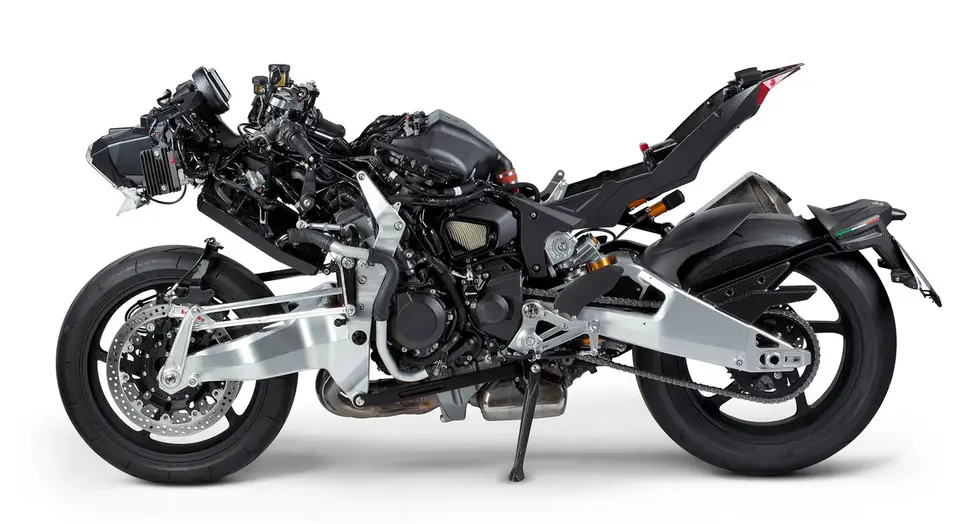
The investment itself was deliberately structured with caution. Through Italian Motorcycle Investment S.p.A., Kawasaki acquired 49.9 percent, while the previous owners retained 50.1 percent. Officially, the goal was to revive development and production in Rimini. Unofficially, there was another objective as well: prestige, a stronger technology image, and a new stage above Kawasaki’s own mass-production lineup.
And that is exactly where Bimota delivers today.
More Than a Badge-Engineering Project
Anyone who feared Kawasaki would simply wrap Japanese hardware in Italian bodywork was only half right. Yes, the engines come from Japan – from the supercharged powerplant in the Tesi H2 to the ZX-10RR-based engine in the KB998 Rimini. But that has always been part of Bimota’s DNA: outside engines, proprietary chassis engineering.
More importantly, there are real products again.
The current lineup makes the point:
· Tesi H2: 231 hp, 141.7 Nm
· KB4: 142 hp, 111 Nm
· KB998 Rimini: 200 hp, 207 kg ready to ride
These are not show bikes built for display cases. They are homologated production motorcycles, still built in Rimini, hand-assembled and deliberately produced in small numbers. That is exactly how a brand like Bimota should operate.
The Real Litmus Test: WorldSBK
Things became truly serious with the return to the Superbike World Championship. Since 2025, BbKRT – bimota by Kawasaki Racing Team – has competed with a clearly defined technical split: Bimota chassis, Kawasaki ZX-10RR foundation.
And the project has worked more quickly than many racing comebacks.
The debut 2025 season already produced four podium finishes, with both riders ending the year inside the championship top 10. At the 2026 season opener at Phillip Island, the team immediately followed that with a double podium in the Superpole Race and temporarily held second place in both the manufacturers’ and teams’ standings.
For a revived niche project, that is remarkably solid performance.
Financially Viable? Probably – but That Isn’t the Point
With typical production runs ranging from 25 to 500 motorcycles per model, Bimota will never become a volume business. That was never the idea. What matters is that Kawasaki has eliminated the brand’s biggest historical weaknesses.
In the past, Bimota repeatedly struggled with:
· developing its own engines
· insufficient capital
· unstable distribution
Today, Kawasaki provides:
· mass-production engines
· an electronics platform
· industrial processes
· a global network
That massively reduces risk and cost. Bimota no longer has to reinvent the world. It only has to do what it has always done best: build exclusive, small-volume motorcycles around distinctive chassis engineering.
Verdict: Quiet, but Effective
The Bimota deal was not an emotional nostalgia exercise. It was a strategically well-structured industrial project. The facts are straightforward:
· stable ownership structure since 2019
· multiple new production models
· WorldSBK comeback with podium finishes
· continued expansion of the dealer network
Bimota has not suddenly become a volume manufacturer – nor does it want to. But the brand is visible again, technically relevant, and credible in racing.
In short, Kawasaki has turned a wounded icon back into a functioning premium toy. Not loudly. Not in huge numbers. But very cleverly.