MotoGP 2027 in Adelaide: More Spectacle, Less Safety Margin?
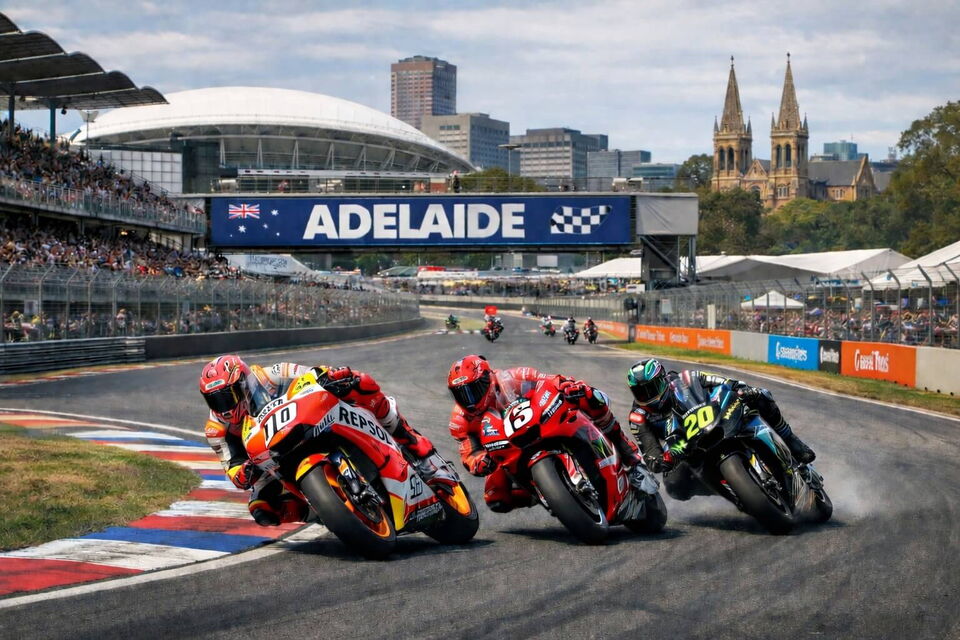
The Australian Grand Prix is getting a new home. Beginning in 2027, MotoGP will leave Phillip Island and relocate to Adelaide — to a street circuit.
Officially, it’s a business and political decision. Unofficially, it raises a more emotional question inside the paddock: does a street race truly fit the premier class of motorcycle racing?
First, the Facts
Phillip Island is not losing the event due to safety concerns. The circuit remains highly respected by riders and widely regarded as one of the sport’s benchmarks.
The move is largely the result of aggressive venue politics. Adelaide reportedly presented the stronger overall package, combined with MotoGP’s strategic push toward urban markets and event-driven destinations.
More city. More spectators. More spectacle.
But that’s exactly where the technical debate begins.
Motorcycles Need Space
Modern Formula 1 cars benefit from survival cells, halo systems, and extensive crash structures. MotoGP riders, by contrast, remain fundamentally exposed.
That makes generous runoff areas essential — not optional.
Permanent circuits like Phillip Island are purpose-built for this reality: wide asphalt runoff, deep gravel traps, and ample space to dissipate energy.
Street circuits operate under very different constraints.
Even with extensive upgrades, walls and barriers inevitably sit closer to the racing line. The result isn’t automatically more crashes — but it does reduce the margin for error when something goes wrong.
And in MotoGP, something eventually always does.
Surface Matters More Than Many Think
Track-grade asphalt is uniform, predictable, and engineered specifically for high-performance motorcycles.
Public roads are the opposite: patches, tar seams, manhole covers, and inconsistent grip levels. Modern MotoGP prototypes are extremely sensitive to these variables, particularly under heavy braking and at maximum lean.
For engineers, that means compromise.
For riders, it means reduced confidence at the limit.
Yes, It Will Be Safe — But How Safe?
Officials are correct in noting that Adelaide must meet strict FIM Grade A homologation standards. Without that certification, no MotoGP bike will turn a wheel.
And with sufficient investment, a street circuit can indeed be made impressively safe.
But that’s not the real question.
The real question is how much safety buffer remains once everything is optimized.
Heritage vs. Event Economics
MotoGP has long balanced sporting purity against commercial expansion.
Street races deliver:
- urban proximity
- broader audiences
- stronger event atmosphere
Permanent circuits deliver what motorcycle racing fundamentally needs: room for mistakes.
Adelaide will work — it has to.
But the departure from Phillip Island is a reminder that not every commercial evolution automatically represents sporting progress.
More spectacle is guaranteed.
Whether the paddock feels equally reassured remains to be seen.