The Dakar Rally: then and now
Why twin-cylinder legends happened—and why 450cc singles win today
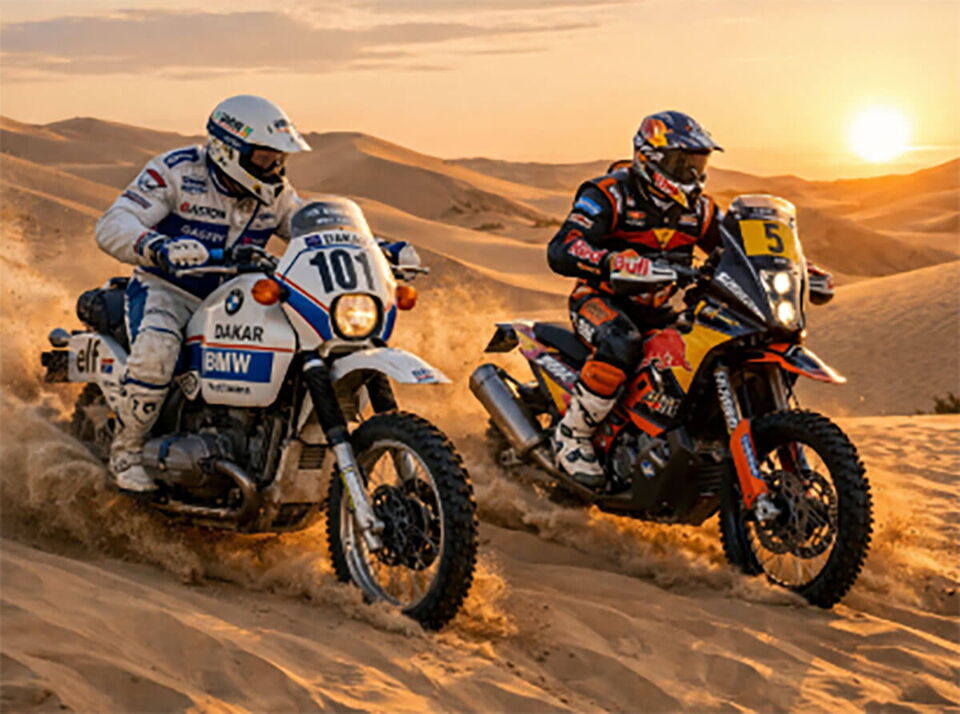
Dakar is more than a race—it’s a myth that’s changed over decades. Watch old footage of huge BMW boxers or big twins charging across endless sand and you can’t help asking: Why did they ride those bikes back then—and why would it be unthinkable today? And maybe more importantly: why are so many fans emotionally attached to that era?
Back then: an adventure with a stopwatch
In the early years, Dakar was less “motorsport” in today’s sense and more an extreme adventure. Stages were longer, often faster, far less secured, and barely standardized. Navigation was a paper map and a compass, help was far away, and if you broke down, you helped yourself.
The bikes matched that spirit: big twins from 750 to over 1000cc offered range, high top speed, and stability on fast desert tracks. They weren’t precision tools—they were rugged long-haul machines built to survive an epic journey. Finishing made you more an adventurer than a racer.
Why those bikes worked then
The stages favored heavy machines: long straights, high average speeds, and comparatively simple routing made weight and inertia less of an issue. Big engines meant bigger reserves—against sand, heat, and fatigue.
The field was also wildly mixed: factory teams, privateers, semi-amateurs—often under very different conditions. Technical superiority or sheer toughness could be decisive. In that context, big twins like BMW boxers or the Honda Africa Twin could dominate—not because they were perfect, but because they fit the rally’s character.
Today: a different competition
Modern Dakar only partly resembles that world. It’s now highly professional, tightly regulated endurance sport. Safety, fairness, and equal opportunity are priorities—so bikes are limited to 450cc, single-cylinder. Big twins aren’t just impractical; they’re simply not allowed.
And even without the rules, they’d have little chance. Stages are more technical, tighter, and much more navigation-heavy. Dunes are ridden slower but for longer stretches. Direction changes, corrections, and precise timing decide everything. In that environment, low weight matters more than raw power.
Why modern 450s win
A current Dakar bike is a specialist tool: light, narrow, perfectly balanced, designed to fatigue the rider as little as possible over many days. Top speed is capped at 160 km/h and monitored by GPS. Being faster brings no advantage—riding cleaner does.
The competition has shifted: not courage and suffering, but precision, consistency, and mistake avoidance. Dakar today isn’t a full-throttle desert marathon—it’s an extremely demanding navigation race.
Why old twins still get romanticized
The love for those old machines has little to do with objective superiority. It’s about a feeling: a time when motorsport seemed untamed, when riders looked like they fought nature and technology alone.
Nostalgia also edits memory. We keep the iconic images and heroes—and forget the downsides: serious accidents, exhaustion, chaos, unfairness. Romance happens in hindsight—not in the bivouac after 800 kilometers.
And aesthetics matter: big tanks, wide engines, deep sound create images that stick. Modern 450s are functional, efficient, and advanced—but they don’t look like monuments.
Conclusion
The old Dakar twins were impressive, brave, iconic—and they made history because they fit their time. Today they’d be out of place: too heavy, too sluggish, too dangerous for a rally that deliberately evolved.
What gets romanticized isn’t the tech—it’s an idea: the wild, open Dakar where anything seemed possible.
Modern Dakar is safer, fairer, athletically more demanding… and more controlled.
But the mythology lives on because of a sense that something was left behind.
Quite simply:
Back then, the winner was the one who endured.
Today, the winner is the one who rides precisely, consistently, and smart.