The Marc Márquez Phenomenon: The Man Riding With One and a Half Arms
Marc Márquez is 33 years old, his right arm is visibly scarred, and some of the muscle has wasted away. His doctor says he is currently riding, in practical terms, “with one and a half arms.” And what does Márquez do? He wins. Against younger riders. Against physically healthy riders. Against Aprilias that on some weekends work at least as well as his Ducati, and sometimes better. Perhaps that is exactly the secret of Marc Márquez: physically, he is worse off than he used to be – but as a racer, he may be better.
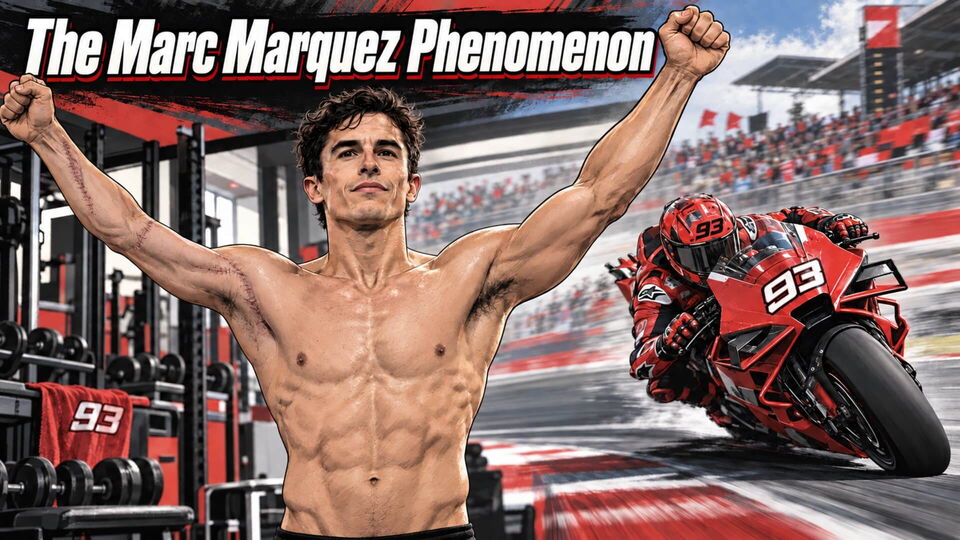
The photo is disturbing.
Marc Márquez is standing shirtless in the gym. At a quick glance, you see a thoroughly trained professional athlete. Look more closely and your eyes stop at the right side. His shoulder and arm look almost emaciated compared with the left. It is not the body you would design for a MotoGP rider expected to wrestle a 300-plus-horsepower motorcycle at the limit for 40 minutes.
And yet this man keeps winning motorcycle races.
Four Grand Prix victories within six race weekends after his latest operation, plus three complete weekend doubles with wins in both the Sprint and Grand Prix. At Aragón, Márquez took all 37 available points. At Misano he again won both Sprint and Grand Prix and even took over the championship lead. After Mugello, he had still been 102 points behind Marco Bezzecchi.
Let those numbers sink in for a moment.
Because they challenge the most obvious explanation for the Márquez phenomenon: he wins because he is riding the best Ducati.
It is no longer that simple.
No, It Isn't Just the Ducati
Of course Márquez is riding a factory bike. Of course the Ducati Desmosedici is an outstanding MotoGP machine. And of course technical changes help him. Márquez himself said early in the season that the aerodynamics and corresponding setup changes made it easier for him to ride with his damaged shoulder.
But anyone who turns that into a story of technical superiority has not watched the 2026 season closely enough.
Aprilia has now built a motorcycle that, depending on the circuit, operates at least at Ducati's level. At Silverstone, Aprilia riders even filled the top three positions in the Sprint. Jorge Martín won while Márquez, struggling with problems, dropped to ninth. And at Misano Ducati and Aprilia were so closely matched that it was difficult to speak of any fundamental technical advantage.
At Aragón, Marco Bezzecchi was also fast enough on the Aprilia to take pole and set a lap record. Márquez still won both Sprint and Grand Prix. Bezzecchi summed it up rather well afterward: with Márquez's experience and speed, he had been unbeatable that day.
The motorcycle explains part of it.
It does not explain the decisive part.
The Old Márquez Wanted to Win Every Yard
Perhaps you have to look backward to understand today's Márquez.
The young Marc Márquez was a force of nature on two wheels. He braked later, saved front-end slides that appeared to have already passed the point allowed by physics, and treated practice crashes almost the way other riders treat a slightly wrong tire pressure.
His method was brutally simple: Where is the limit?
A little farther.
And a little farther.
Ah, there it is.
Gravel trap.
Back to the garage, repair the motorcycle, store the information.
That willingness to define the limit through a crash if necessary was part of his superiority. Márquez could take risks others either would not or could not take. His reflexes, his enormous mobility on the motorcycle, and especially his ability to catch a folding front tire with knee, elbow, and pure instinct moved the boundary of what seemed possible on a MotoGP bike.
It worked astonishingly well for a long time.
Until Jerez 2020.
After that, the invulnerable Márquez became human.
And perhaps that was when the extraordinary motorcycle rider began to become the complete racer.
His Body Forced Him to Become Smarter
Nine operations on his right arm since 2019 – including seven procedures involving the shoulder and upper-arm area alone – have left their mark. After another major setback in 2025 and further surgery, strength is significantly reduced, particularly around the right biceps. His doctor, Samuel Antuña, has said openly that Márquez no longer has a normal right arm and probably never will again.
That is not a minor limitation.
On a MotoGP bike, the right arm controls the throttle and front brake. Under hard braking, the rider has to support enormous deceleration forces, control the motorcycle during changes of direction, and at the same time process the finest feedback from the front end.
At Silverstone, the limit became visible. Márquez even reported internally that at times he did not have adequate control of his right arm. The circuit became a kind of kryptonite for his physical condition.
The 2019 Márquez might have responded by attacking even harder.
The 2026 Márquez has to respond differently.
He has to manage himself.
And ironically, that necessity may have made him an even more dangerous opponent.
He Has Learned to Accept Bad Days
That may be the biggest change of all.
In the past, Márquez seemed to regard sixth place as a personal insult. If the motorcycle was good for fifth, he tried to squeeze second out of it. Sometimes it worked.
Sometimes he ended up on the ground.
Today he understands better that a championship is not won on the days when everything works. Plenty of top riders can win on those days.
It is won on the other days.
When the body is not cooperating.
When the tire fades.
When the circuit does not suit the motorcycle.
When an Aprilia rider is two tenths faster.
Then the job is not to win at all costs. The job is to keep a seventh place from becoming a zero.
That sounds simple. For Marc Márquez, it was probably one of the hardest lessons of his career.
After his surgery, he himself described how he had to adapt his riding style to the arm. In longer races he sometimes deliberately rides more calmly because he still lacks physical endurance.
That is remarkable.
The man whose career was long built on ignoring limits now also wins because he has learned to accept them.
His Greatest Strength Is Adaptability
Álex Márquez calls his brother a “chameleon” rider. That is a very accurate description. His brother's body is now visibly asymmetrical because other muscle groups have to compensate for what is missing on the right side.
Exactly the same compensation happens in his riding.
If Márquez can no longer ride a corner the way he used to, he finds another solution.
If he can no longer absorb the load through his right arm, he changes his body position and the motorcycle setup.
If he lacks strength over race distance, he has to decide earlier when an attack is worth making.
That is race intelligence.
And it is what separates a very fast rider from a great champion.
Pedro Acosta may now possess more explosive youth. Bezzecchi currently has an Aprilia that works superbly at some tracks. Jorge Martín has enormous speed. Bagnaia has proved that he can become world champion.
But Márquez has something none of those riders can buy, train, or download from telemetry:
He has experienced practically every situation there is.
He knows dominance.
He knows pressure.
He knows crashes.
He knows world championships.
He knows defeat.
He knows motorcycles that do not work.
And by now he even knows the very real possibility that his career could be over.
That changes a rider.
The Real Secret Is Information Processing
MotoGP is often reduced to courage. Brake later and you win.
That is nonsense.
At this level, they can all brake late.
The difference is how quickly a rider processes information and turns it into decisions.
Grip. Tire temperature. Wind. Braking point. Electronics. Line. Opponent. Physical condition. Race distance. Risk.
A modern MotoGP rider is constantly solving equations at 190 mph without ever seeing an equation.
And after more than a decade in MotoGP, Márquez has an enormous database stored in his head.
He does not merely know how a situation feels.
He often already knows what is going to happen next.
That is the advantage of age, as long as the raw speed is still there.
At 23, Márquez had to solve many things with talent.
At 33, he can multiply talent by experience.
And Then There Is That Will to Win
The psychological side should not be underestimated, either.
Many racers want to win.
Marc Márquez seems to hate losing.
There is a difference.
His career after 2020 would have given almost any other rider a perfectly legitimate reason to stop at some point. Multiple operations. Pain. More injuries. Honda's crisis. A career move. Then more injuries.
As a multimillionaire and multiple world champion, he could easily have said: Enough.
He did not.
He even left Honda, the manufacturer with which he had written almost his entire MotoGP success story, and accepted a major loss of status for 2024 to join Gresini on a year-old Ducati and find out whether he could still win.
That may have been the most important decision of his second career.
Because Márquez did not want a comfort zone.
He wanted an answer.
Am I still fast enough?
By now, we know the answer.
Maybe Today He Isn't Racing the Others Anymore
The photo of the wasted right arm therefore takes on a deeper meaning.
Márquez later explained that he had posted it deliberately. The constant questions about his arm were draining his energy. The picture was meant to end the discussion: This is what the arm looks like. This is reality. Now let's talk about racing again.
That says a great deal about his mentality.
He does not want pity.
He does not want a hero story, either.
He wants points.
Perhaps that is the core of the phenomenon.
The young Márquez raced Rossi, Lorenzo, Pedrosa, and Dovizioso.
Today's Márquez is primarily racing the difference between what would theoretically be possible and what is actually possible on this particular Sunday with this body, this motorcycle, and this tire.
And he has become frighteningly good at it.
Is Marc Márquez the Greatest of All Time?
This is where things get dangerous.
Giacomo Agostini owns numbers from another era that are almost impossible to compare. Valentino Rossi shaped modern motorcycle racing like perhaps no one else. Mike Hailwood proved his greatness on machines and in disciplines whose level of danger is almost unimaginable today.
That is why there is no objectively measurable “greatest motorcycle racer of all time.”
But Marc Márquez now has an argument that goes beyond title totals.
We have seen several versions of the same exceptional rider.
The young phenomenon. The dominant world champion. The crash artist. The injured rider. The man who nearly failed. The comeback rider.
And now the physically limited veteran who beats younger, healthy world-class riders on equal or, at times, superior machinery.
That may be more impressive than his early titles.
Back then Márquez sometimes seemed superhuman.
Today we know that he is not.
You can even see it in the photo.
The Secret of Marc Márquez
So what is his secret?
Not the Ducati.
Not the factory team.
Not some magical setup.
Not his experience.
Not his talent.
Not his tolerance for pain.
Not his will to win.
It is the sum of all of those things – and above all his ability to keep changing the weight he gives each one.
The young Márquez compensated for a lack of experience with talent and risk.
Today's Márquez compensates for physical deficits with experience, technical understanding, adaptability, and race intelligence.
He no longer has to be the fastest rider in every corner.
On Sunday, he only has to understand earlier than everyone else where he needs to be fast, where he needs to wait, and which risks are worth taking.
Perhaps that is the final stage in the development of an extraordinary racer.
Marc Márquez has lost part of his physical capability.
In return, he has gained something you cannot possess at 20: the ability to read his own limits just as precisely as those of his motorcycle and his rivals.
In the past, Marc Márquez wanted to win every race at any cost.
Today he knows how to win a world championship.
And that may be the bigger problem for his rivals.