The Pecco Bagnaia Mystery: How Does a World Champion Forget How to Ride?
Two-time world champion, twice runner-up, 31 MotoGP victories with Ducati – and suddenly Francesco “Pecco” Bagnaia is riding the same motorcycle Marc Márquez wins on and at times fighting around 15th place. At Misano he crashes out of his home Grand Prix yet again, his fourth retirement in five Grands Prix. The strange part is that nobody seems to know exactly why. Not Ducati. Not Bagnaia. Apparently not even the data engineers. Is the GP26 to blame? Ducati? His head? Or are we watching a highly sensitive perfectionist despair over a MotoGP bike that no longer speaks his language?
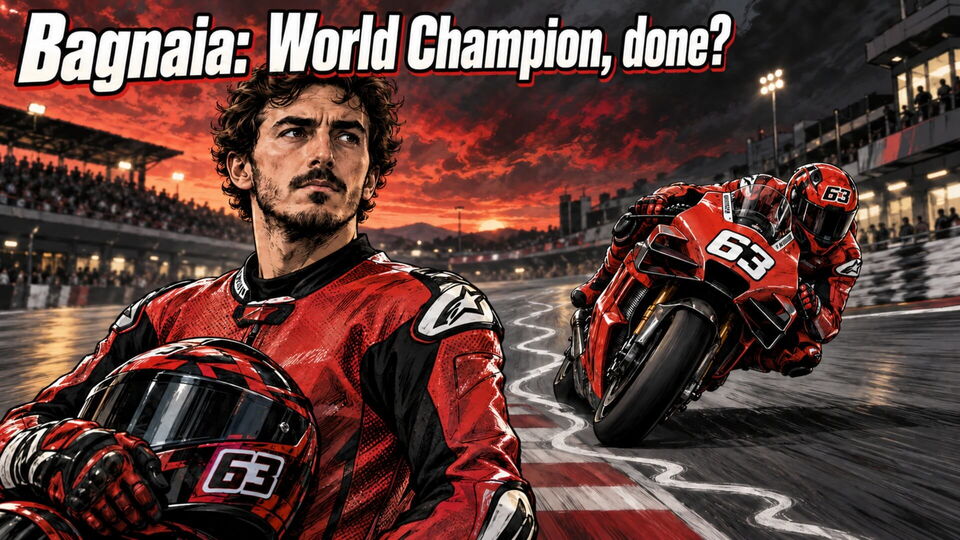
You would normally start to worry if Pecco Bagnaia suddenly said he could no longer ride a motorcycle.
The problem is that this is exactly what it currently looks like.
Misano is the perfect crime scene. Bagnaia knows this circuit better than almost any other. He trains here. He has been fast here. In 2024 he ran a 1:30.031. Two years later, Friday's timing screen shows a 1:31.4. Almost a second and a half slower. Not on a Yamaha. Not on a Honda. On a factory Ducati, while other Ducati riders are running at the front.
And Bagnaia says something that sounds almost alarming coming from a two-time MotoGP world champion:
He is riding slowly – and still constantly risks crashing.
That is the real heart of the problem. Not 14th place. Not 19th. Not the gap to Márquez.
It is that a rider of his caliber has lost the connection between what he does and how the motorcycle responds.
Pecco Hasn't Suddenly Become Slow
Start with the simplest explanation.
Bagnaia has not suddenly forgotten how to ride a motorcycle.
This man won the MotoGP World Championship in 2022 and 2023. In 2024 he won eleven Grands Prix and still narrowly lost the title to Jorge Martín. Ducati quite rightly describes him as part of one of the most successful rider-motorcycle combinations in its MotoGP history.
That does not disappear over a winter. Talent does not evaporate.
The popular paddock-bar theory that marriage and now fatherhood have made him slower is not very convincing, either. Bagnaia has been a father only since June. His difficulties began much earlier. The GP25 was already making his life difficult in 2025. Anyone who uses the birth of his son to explain two difficult seasons is confusing timing with causation.
Of course a family changes a person. Perhaps it changes perspective. Perhaps life away from the racetrack becomes more important.
But Bagnaia does not look like a man who suddenly no longer cares about motorcycle racing. Quite the opposite. He looks like a man being eaten alive by the fact that he does not understand why he is slow.
That is something entirely different.
The Problem Lives Between the Brake Lever and the Apex
To understand Bagnaia, you have to understand his riding style.
Pecco is not Márquez.
He was never the rider who grabs a bad motorcycle by the neck, throws it into a corner, and then sees what happens.
Bagnaia needs precision.
His great strength was always the braking phase. Brake extremely late, decelerate the motorcycle cleanly, carry residual brake pressure into lean angle, load the front, hit the apex, and then accelerate as efficiently as possible.
It looks less spectacular than Márquez's riding style. But when it works, it is brutally fast.
The problem is that this system only works if the rider has complete confidence in the front tire.
And that is exactly what Bagnaia lost with the GP25.
In 2025 he described the crucial difference from the past himself: under straight-line braking, things were still more or less okay. The problem began at turn-in. In the past he could continue slowing the motorcycle while leaned over. With the GP25, he no longer had the feel to do that.
That sounds like a small thing. For Bagnaia, it is not.
It is like telling a pianist that three keys on his grand piano will now have a different pressure point.
Of course he can still play the piano. Just not the way he learned to play at a world-class level.
The GP25 Hit Pecco Exactly Where It Hurt
That there really was a technical factor in 2025 is illustrated by an interesting story from brake development.
Bagnaia discovered that larger 355-millimeter brake discs gave him more confidence. Together with Brembo, a lighter 355-mm version was eventually developed that could also be used on tracks where the heavy large discs would normally be problematic from a thermal standpoint.
Suddenly Pecco could brake differently again. Less force at the lever. More braking torque. More control. More Pecco. And sure enough, early and midway through 2026 he came back.
Not dominant like 2022 or 2023. But competitive. Before the summer break, he finished on the podium four times in a row.
That is an important point. Because it does a pretty good job of disproving the theory that Bagnaia is simply “satisfied” or no longer hungry.
A rider who has lost his hunger does not suddenly rediscover speed through a technical change.
A technically blocked rider does.
And Then It All Started Again
Since Silverstone, the house of cards appears to have collapsed again.
This time Bagnaia describes the problem in even stranger terms.
He brakes harder than the other Ducati riders – but decelerates less.
He tries to meter the throttle especially smoothly – but accelerates worse.
The rear offers little grip.
The engine braking feels strange.
The motorcycle becomes nervous.
And setup changes subjectively seem to make almost no difference.
For a racer, that is the worst-case scenario.
If a motorcycle understeers badly, you can work on it.
If the rear pumps under acceleration, you can work on it.
If the front dives too far under braking, you can work on it.
But what do you do when you make a change – and the rider says: same?
Another change.
Same.
Álex Márquez's setup.
Same.
Marc Márquez's setup.
Same.
Their electronics.
Same.
At some point, it is no longer only the motorcycle that is in question. The entire understanding of the problem is in question.
Why Can the Other Ducati Riders Ride It?
And that brings us to the most uncomfortable question.
If the Ducati really is that bad, why does Marc Márquez win on it?
Why is Álex Márquez fast? Why can other Ducati riders deal with it?
Bagnaia himself now gives a remarkably clear answer: the others are fast, so he has to adapt as well.
That is fair. But it is only half the truth.
A MotoGP motorcycle does not simply possess the quality “good” or “bad.” What matters is the interface between machine, tire, and rider.
Marc Márquez can load a motorcycle differently from Bagnaia. He can accept movements that already cost Pecco confidence. He can improvise a line. He can control the motorcycle more aggressively with his body. And above all, Márquez has an extraordinary ability to make an imperfect situation fast anyway.
Bagnaia himself has admitted that “overriding” problems was never one of his particular strengths.
That is not an admission of insufficient talent. It describes the type of rider he is.
Pecco is a precision rider.
Márquez is a problem solver.
When the motorcycle works perfectly, the precision rider can be just as fast or faster.
When it does not work, the difference begins.
Why Doesn't Márquez's Setup Work for Pecco?
Because a setup is not an Excel file. That is something racing likes to forget. You copy the spring, damping, ride height, engine braking, and electronics from the faster teammate – and then expect his lap time.
Nonsense.
The setup works together with the rider.
A rider who brakes later and harder creates different loads.
A rider who carries the brake deeper into the corner loads the front tire differently.
A rider who opens the throttle earlier changes pitch, tire temperature, and slip.
Body size, seating position, forces at the handlebars, speed during direction changes: everything is connected.
Marc Márquez's setup without Marc Márquez is just the setup.
The decisive sensor is sitting on top of it.
And Now the Head Gets Involved
Of course by now it is psychological as well.
How could it not be?
Confidence works like a bank account in motorcycle racing.
Every little slide makes a withdrawal.
Every unexplained crash withdraws more.
Every weekend when your teammate wins while you circulate around 15th costs something extra.
Eventually the account is empty.
Then something dangerous happens: the rider starts riding defensively.
That is exactly what Bagnaia now says he is doing.
And riding defensively in MotoGP does not automatically mean riding more safely.
The motorcycle may no longer be loaded decisively enough. The tire does not work in its optimal window. The lines change. The braking phase gets longer. Corner entry gets worse. That leads to worse acceleration.
The rider gets slower.
Because he gets slower, he tries harder somewhere else.
Then he crashes.
And confidence drops even further.
A perfect negative feedback loop.
Is Ducati to Blame?
Partly.
Ducati should not be absolved of responsibility simply because Marc Márquez wins races.
For years, Bagnaia was the reference rider for this project. If that very rider cannot use certain characteristics of two successive generations of the motorcycle, that matters to a manufacturer.
Especially because Bagnaia is convinced that the GP24 was the better motorcycle for him.
Ducati, for its part, stresses that it will work with him until the final lap. So at least outwardly, this is not a lack-of-support issue.
But of course the balance of power has changed.
Pecco used to be the world champion around whom Ducati revolved. Today Marc Márquez sits on the other side of the garage. And in 2027 Pedro Acosta will sit there. Bagnaia is leaving.
That does not mean sabotage or that Ducati has technically abandoned him. Conspiracy theories like that are usually nonsense.
Psychologically, however, it still changes something.
The man who made Ducati world champion again is no longer the center of the Ducati universe. The center is Márquez.
The Most Dangerous Opponent Is Now Inside Pecco's Head
That brings us to the real mystery. Bagnaia probably does not have one single problem. He has several problems that reinforce one another.
The GP25 took away exactly the feeling in 2025 on which his riding style was based.
The GP26 gave some of it back for a while, but did not solve everything.
Since Silverstone, a new technical or dynamic problem has appeared that apparently even Ducati cannot yet explain cleanly.
The repeated crashes have cost confidence.
The lack of a clear relationship between setup changes and improvement creates helplessness.
And meanwhile his teammate, with a physically damaged arm, is fighting for victories and the world championship.
You could hardly hold up a more painful mirror to a perfectionist.
Bagnaia knows how fast he should be. He has the data. He sees Marc. He sees Álex. He sees his own old lap times.
And still he cannot get there. That is probably far more psychologically punishing than finishing last on an objectively bad motorcycle.
Aprilia May Be Exactly the Medicine He Needs
Bagnaia moves to Aprilia in 2027. At first glance, it looks like an escape. But perhaps it is exactly what he needs. Not necessarily a better motorcycle. A different one.
Sometimes a poisoned rider-motorcycle relationship can no longer be repaired. Every new attempt reminds you of the previous one.
Every corner contains the memory of the last slide.
Every engineer searches the same data.
Everyone works from the same basic assumptions.
At Aprilia, Bagnaia starts from zero. Different ergonomics. Different aerodynamics. Different engine character. Different electronics philosophy. Different engineers. A different language between rider and motorcycle.
And above all: no GP24 in the back of his mind.
That could be enormously important. Because Bagnaia currently seems to be constantly searching for a feeling he once had.
At Aprilia, he cannot search for that same feeling. He has to develop a new one.
But Aprilia Will Not Automatically Save Him
This should not be turned into a fairy tale, either.
Marco Bezzecchi shows how fast the Aprilia can now be. At Misano he became the first rider ever to lap under 1:30 and set a new circuit record.
So Bagnaia is not getting a consolation prize in 2027. He is getting a motorcycle on which another rider has demonstrably been very fast. And that is what makes it interesting.
If Pecco starts winning again there, we will know in retrospect pretty clearly what happened: Bagnaia was never gone. The connection between Bagnaia and Ducati was gone.
If he has the same problems on the Aprilia, develops the same doubts, and once again searches for that one perfect feeling, then the diagnosis becomes more uncomfortable. Then the problem really does lie more with the rider.
The Secret of the Disappearing World Champion
So what happened to Pecco Bagnaia?
He is not satisfied.
He has not suddenly become too old.
He did not become slow because he got married and had a child.
And he certainly has not forgotten how to ride a motorcycle.
His problem is more subtle.
Bagnaia needs confidence to create speed. And he needs speed to create confidence.
That cycle has broken. Marc Márquez can apparently ride fast even when he does not completely trust the motorcycle. Bagnaia has to trust it in order to ride fast.
That sounds like a small difference. In MotoGP, it is a world of difference.
Perhaps what we are seeing is not the decline of a world champion at all, but an extreme version of a problem every motorcyclist knows.
If you do not trust the front tire, you are slow.
If you still try to be fast, you tense up.
If you tense up, the motorcycle works even worse.
And eventually you no longer know whether the tire is sliding because the motorcycle is not working – or because you stopped riding the way you need to ride a long time ago.
Pecco Bagnaia is caught in exactly that vicious circle.
So perhaps Aprilia does not even need to build him a better motorcycle for 2027. It has to achieve something much harder: They have to give him a motorcycle he believes in again. Then the world champion could reappear very quickly.
If not, two bad Ducati years will become something else. Then we will no longer be talking about a technical crisis. We will be talking about the end of an era.